Debugging the Voucher #01 Product Receipt in D365 F&O
Every D365 F&O consultant has had this conversation. Finance opens a product receipt voucher and asks why inventory clearing shows INR 1,100 when the goods cost INR 1,000. Or why Accrued Purchases is INR 100 short of the vendor bill. Or why a P&L freight account has a credit balance in the middle of the month.
The voucher tells you what D365 posted. The real investigation begins when you trace each posting type back to the configuration that determined why the entry was created and which account was selected. There are five or six parameters spread across Inventory management, Cost management, Procurement and Accounts payable. A product receipt (GRN) touches all of them at once.
This post is the first in the Debugging the Voucher series. I posted multiple GRN scenarios in a test legal entity (INMF) and took screenshots of every voucher. For each line I traced back the setting that produced it. The aim is simple: next time a GRN voucher looks wrong, you should know exactly which setup to open first.
TL; DR
|
How to read the findings
These are test results from one environment, so I separate what the system did from why I think it did it:
Label | Meaning |
|---|---|
Observed | What this D365 environment posted, as shown in the voucher screenshot |
Configuration | The setup present when the test was run |
Interpretation | Why I believe the voucher was generated as it was |
Expected behaviour | What I expect under a different setup, still to be validated |
Treat everything here as a starting point and re-test in your own environment before relying on it. Vendor invoice posting is out of scope for this post; it is the subject of the next one.
A product receipt can generate up to two vouchers. Once you know which one carries which line, most GRN questions answer themselves.
Voucher | What it records | Posts when (in these tests) |
|---|---|---|
Physical inventory voucher | The accounting impact of the physical receipt, using the configured physical inventory posting accounts | Stocked item, Post product receipt in ledger = Yes and Post physical inventory = Yes on the item model group |
Product receipt (accrual) voucher | The accrued purchase liability and, where enabled, the receipt-stage tax | Accrue liability on product receipt = Yes (stocked items), or any procurement category line |
Physical inventory voucher. The receipt value is debited to Inventory Clearing – Received, un-invoiced (142100). The matching credit goes to Purchase expenditure, un-invoiced (200125). Note that 142100 is a clearing account picked by the physical posting setup. It is not the final inventory asset account, which only gets hit at invoice.
Product receipt (accrual) voucher. This debits Purchase expenditure, un-invoiced (200125) and credits Accrued Purchases (200190). Where GST is accrued at receipt, it also debits the configured tax account.
Put the two together and 200125 cancels out, leaving inventory clearing on the debit side and Accrued Purchases on the credit side. That is the shape of a clean GRN. In my tests, three patterns showed up:
Receipt pattern | Vouchers observed | Scenarios |
|---|---|---|
Stocked item, physical posting enabled | Physical inventory voucher + accrual voucher; 200125 nets to zero (except Scenario 14) | 1–9, 11, 13, 14 |
Service on a procurement category line | Accrual voucher only; expense posted straight to the category’s un-invoiced account | 12A, 12B |
Stocked item, post physical inventory disabled | Accrual voucher only; 200125 is debited with no physical offset | 10 |
It helps to split the setup into two groups. One group decides whether a line posts at receipt at all. The other decides which account it lands in. A missing line and a wrong account are diagnosed in different places, so keep them apart in your head.
Settings that decide whether a posting happens
Setting | Where | Value in tests | Effect at product receipt |
|---|---|---|---|
Post product receipt in ledger | Inventory and warehouse management parameters > Inventory accounting | Yes | Posts the physical inventory voucher to the GL. Separate from the liability accrual, which is controlled on the item model group. |
Post physical tax | Same page, Physical posting | No (S1, S7); Yes (other scenarios) | Tax is always calculated on the PO. This decides whether it is also accrued to the ledger at receipt, ahead of the final tax posting at invoice. |
Post physical inventory | Item model group > Ledger integration | Yes; No (S10) | Allows receipt-stage transactions for the group to post to the ledger. |
Post financial inventory | Item model group > Ledger integration | Yes | Invoice-stage posting. Does not change the GRN voucher but is needed for the receipt to clear at invoice. |
Accrue liability on product receipt | Item model group > Recognition of cost | Yes | Creates the accrual voucher crediting Accrued Purchases. |
Inventory model | Item model group | FIFO; Standard cost (S11) | FIFO values the receipt at PO price. Standard cost values it at standard and posts the difference as a variance. |
Generate charges on product receipt | Procurement and sourcing parameters > Delivery | Yes | Brings eligible PO line charges into the receipt so they post at GRN. |
What about charges? Observed: a Pcs. category freight charge with Debit type Item posted at receipt, both with Credit type Ledger account (Scenarios 5–6) and with Credit type Customer/Vendor (Scenario 7). |
If Post product receipt in ledger in Inventory parameters is No. The physical inventory transaction is still updated, but no physical inventory voucher reaches the GL. Also, No posting of accrual voucher and receipt-stage charges.
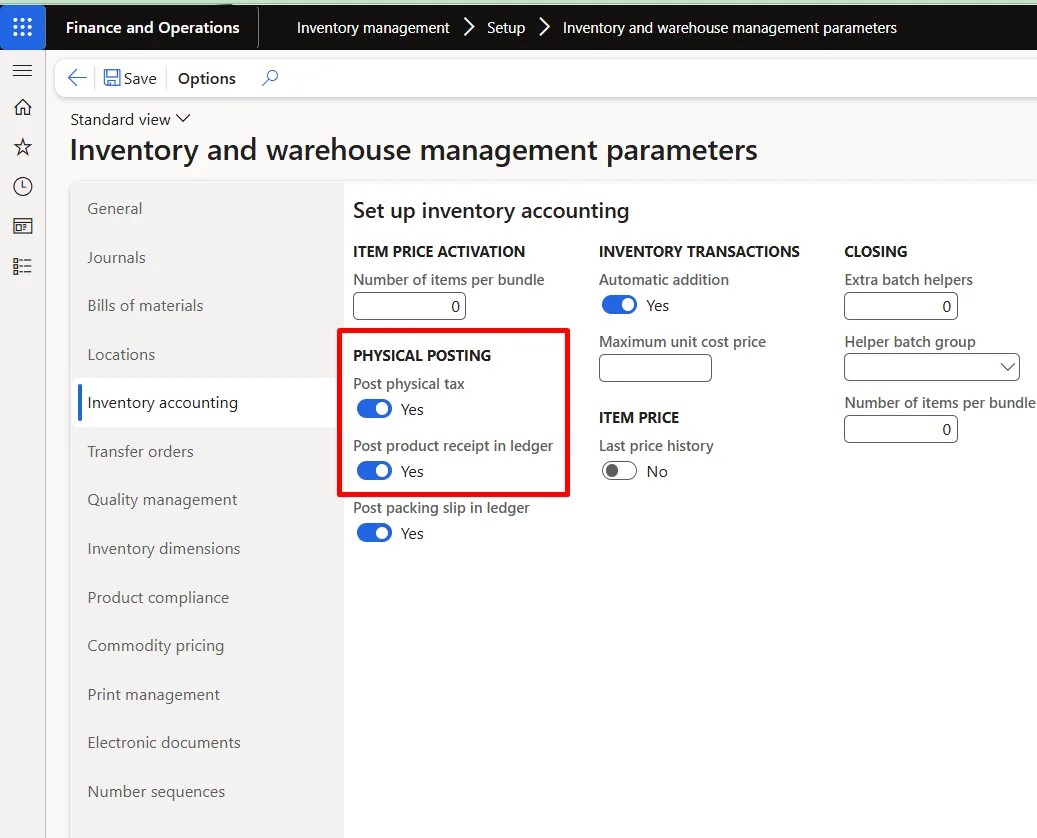
Inventory and warehouse management parameters – Post product receipt in ledger & Post physical tax set to Yes
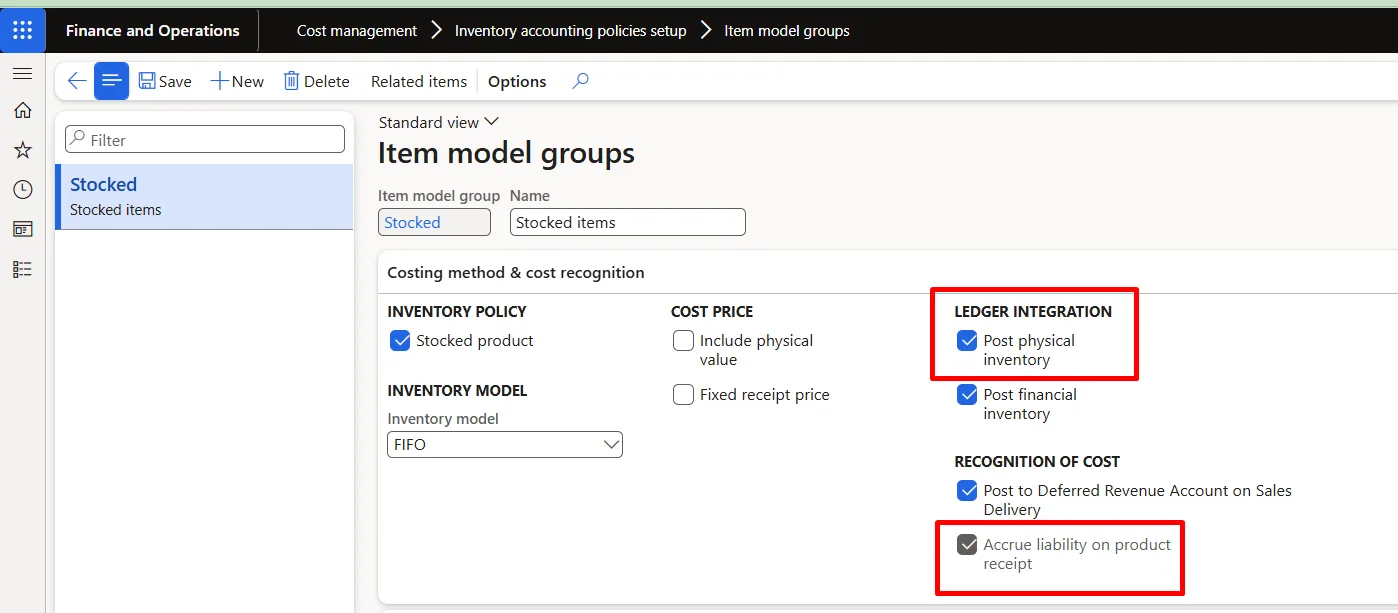
Item model group Stocked – Post physical inventory and Accrue liability on product receipt
Settings that decide which account is used
In this environment, almost every GRN account comes from one place: Inventory management > Setup > Posting > Posting.
Posting type | Account-determination source | Relation in this environment | Account |
|---|---|---|---|
Cost of purchased materials received | Purchase order | Item groups | 142100 |
Purchase expenditure, un-invoiced | Purchase order | Item groups | 200125 |
Purchase expenditure, un-invoiced | Purchase order | Category: Repair & Maintenance | 605141 |
Purchase, accrual | Purchase order | All items | 200190 |
Purchase price variance | Standard cost variance | Item groups | 510310 |
Purchase charges, freight | n/a – charge code 01, Credit Ledger account | Charge code | 600120 |
India GST (receipt stage) | n/a – India GST tax configuration | Tax 18%, recoverable | 131130 |
India GST (reverse charge) | n/a – India GST tax configuration | Tax 18%, reverse charge 100% | 131230 / 223130 |
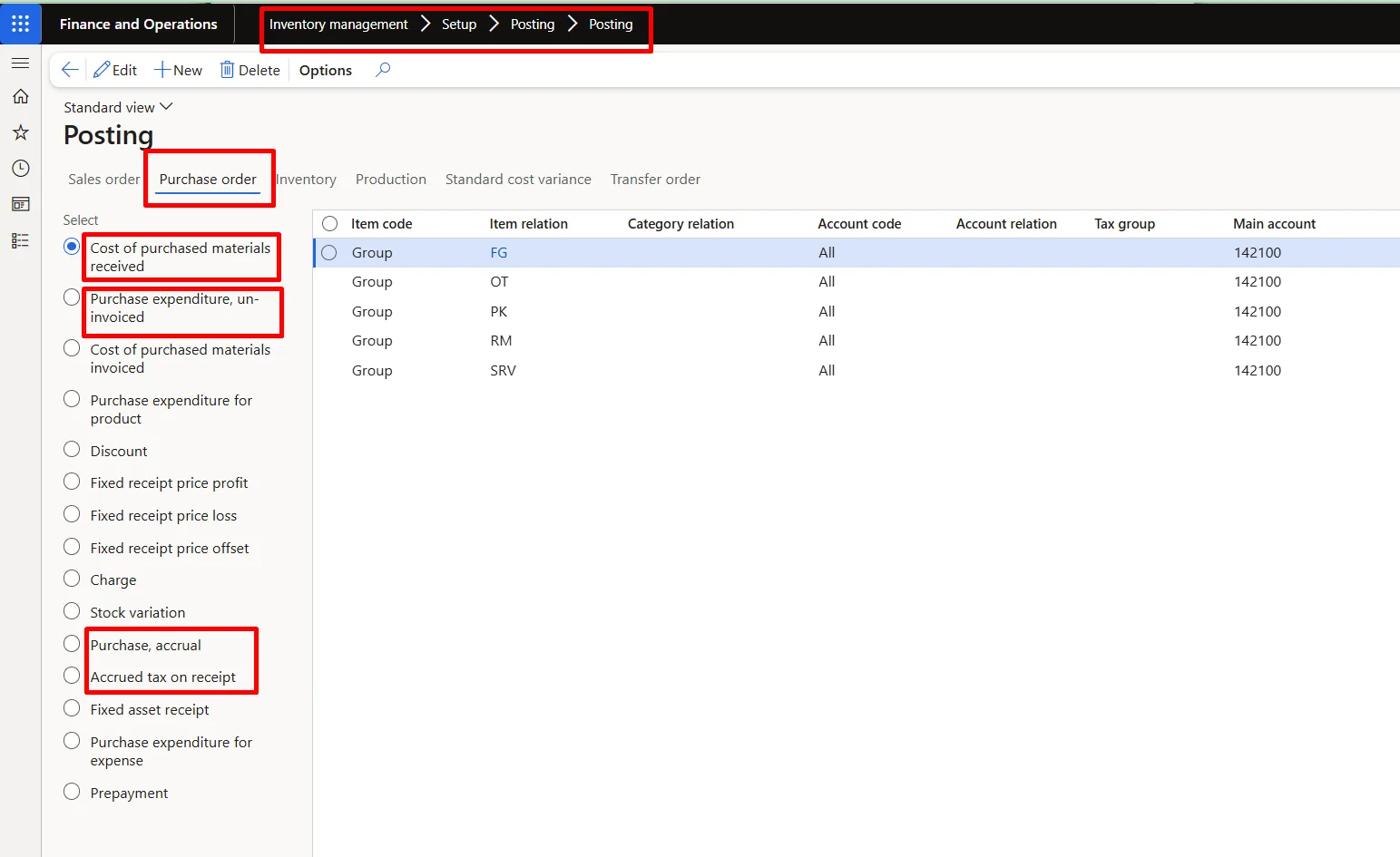
Inventory posting – Purchase order tab, showing the posting types used at product receipt
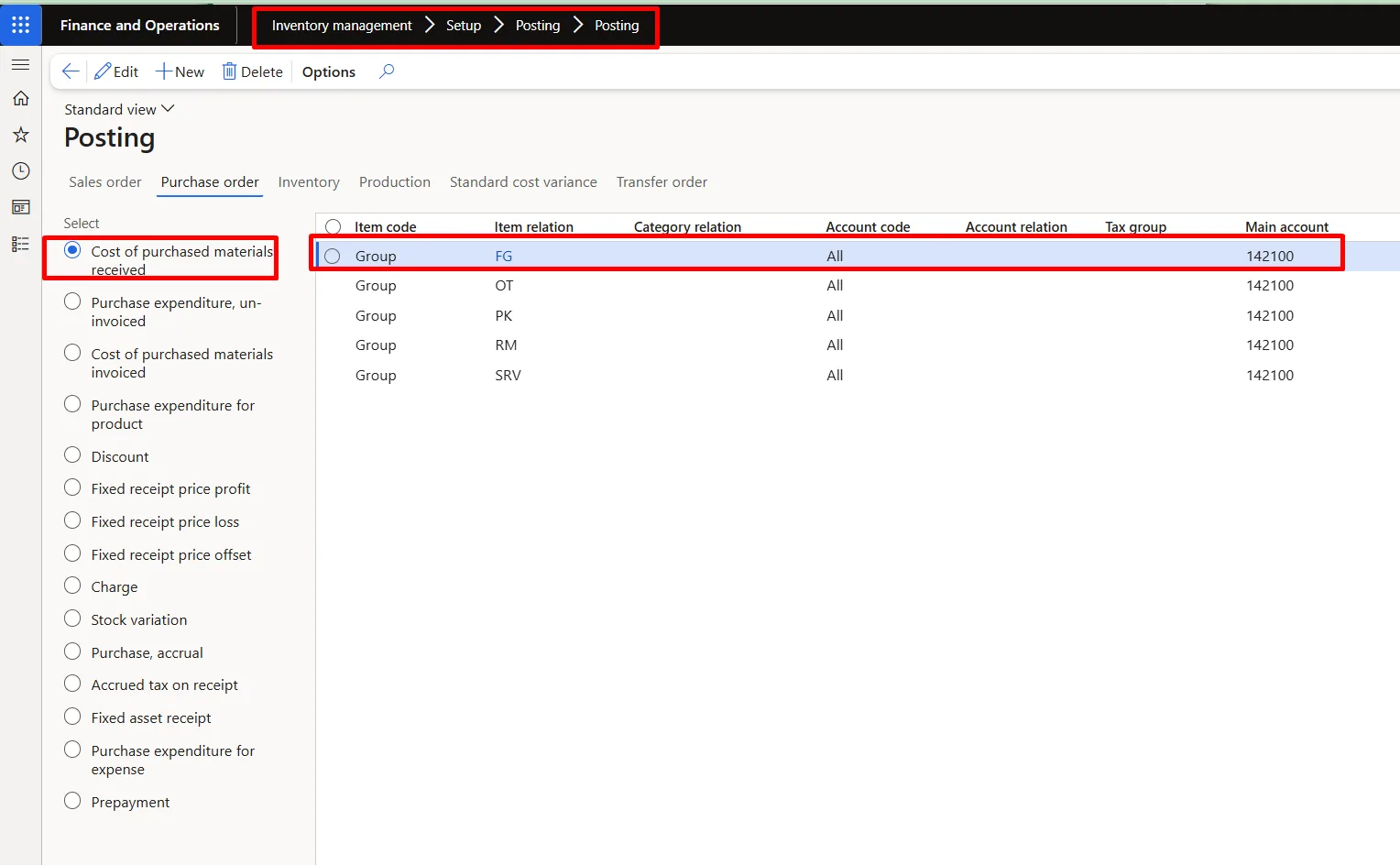
Cost of purchased materials received – item groups mapped to 142100
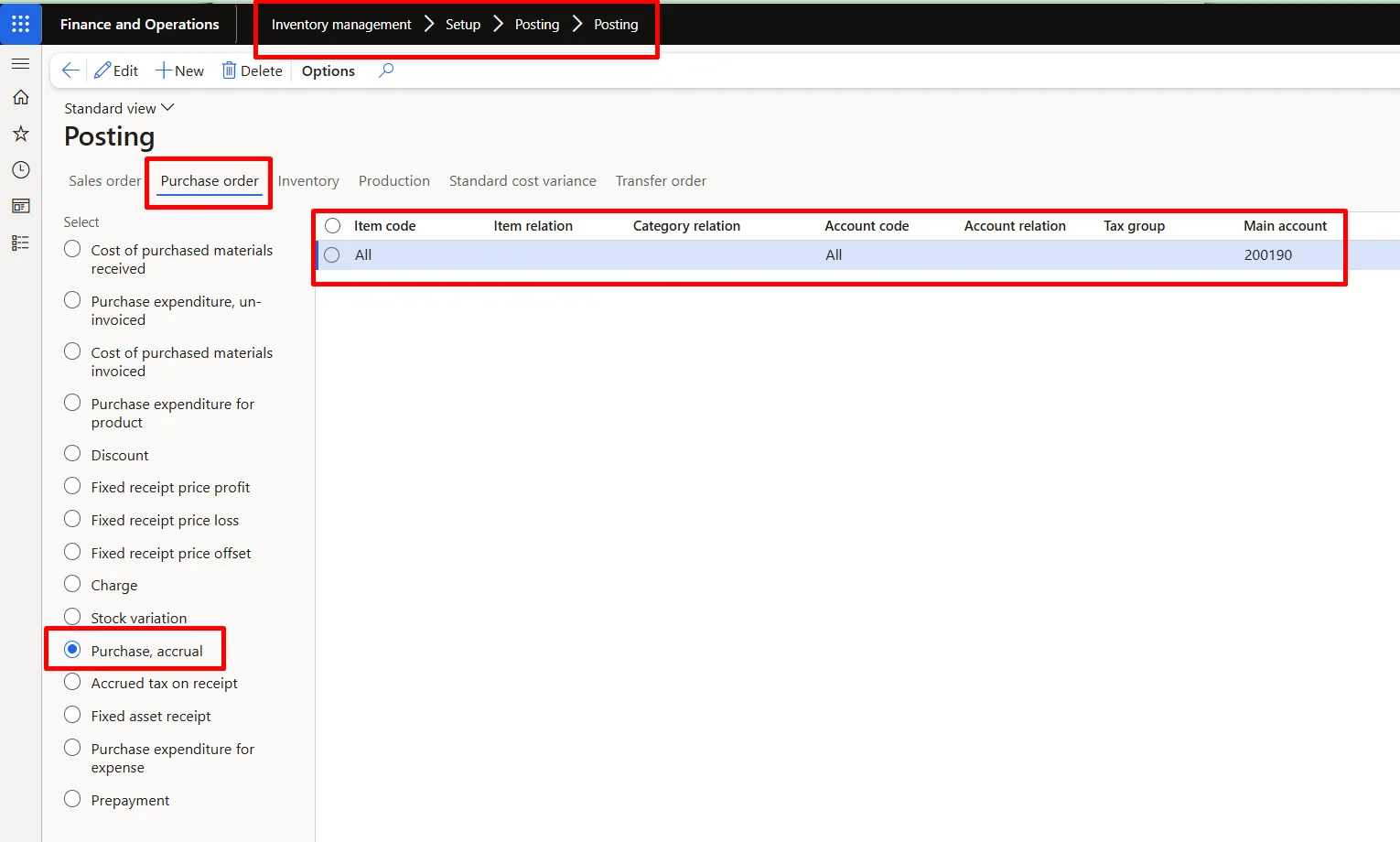
Purchase, accrual – all items mapped to 200190
These posting types appeared across all fourteen scenarios. Keep this table open while you read a GRN voucher. It is an inventory of what I observed, not every posting type a receipt can generate.
Posting type | Scenarios | Account | Dr / Cr at receipt | What it represents |
|---|---|---|---|---|
Cost of purchased materials received | 1–9, 11, 13, 14 | 142100 Inventory Clearing | Dr (Cr on cancel/correct/return) | Receipt value of goods, including Item-type charges and tax loaded on inventory |
Purchase expenditure, un-invoiced | 1–11, 13, 14 | 200125 AP – Uninvoiced | Cr in physical, Dr in accrual | Bridge between the two vouchers |
Purchase expenditure, un-invoiced (category) | 12A, 12B | 605141 Provisional – Repair Expenses | Dr | Un-invoiced service expense |
Purchase, accrual | 1–14 | 200190 Accrued Purchases | Cr (Dr on cancel/correct/return) | Accrued liability; in Scenario 7 also carries the Customer/Vendor charge |
India GST | 2, 5, 6, 8, 12B | 131130 Accrued IGST recoverable | Dr | Receipt-stage tax accrual |
India GST (reverse charge) | 3 | 131230 Accrued IGST RCM recoverable / 223130 Accrued IGST RCM payable | Dr / Cr | Receipt-stage tax payable by the recipient, with matching input credit |
Purchase charges, freight | 5, 6, 8 | 600120 Freight/Transportation In | Cr | Offset for freight loaded onto the item |
Purchase price variance | 11 | 510310 Purchase Price Variance | Dr (unfavourable) | PO price above standard cost |
Where to look when an account is unexpected
Posting type | Check first | Then check |
|---|---|---|
Cost of purchased materials received | Inventory posting > Purchase order tab, by item / group / all | Item group on the released product; a more specific item-level row overriding the group |
Purchase expenditure, un-invoiced | Whether the line is an item or a procurement category | Category-level rows in the same posting type |
Purchase, accrual | Inventory posting > Purchase order tab | Vendor-specific or item-specific rows |
India GST | Tax document on the receipt | Tax code on the PO line, ITC eligibility, Post physical tax |
Purchase charges, freight | Charge code > Posting | Credit type and ledger account on the charge code |
Purchase price variance | Standard cost variance tab | Active cost version and site on the item price |
Procurement category expense | Category row on Purchase expenditure, un-invoiced | Category hierarchy inheritance |
Each scenario builds on the one before it. Scenario 1 is the baseline; every later voucher is easiest to read as “Scenario 1, plus one change.”
Scenario 1: The baseline – stocked item, no tax, no charges
Business scenario: Goods worth INR 1,000 (10 units at INR 100) are received against PO INMF-000335 with no GST and no charges.
Configuration: FIFO stocked item (item model group Stocked) with Post physical inventory, Post financial inventory and Accrue liability on product receipt enabled. Post product receipt in ledger = Yes; Post physical tax = No.
Voucher | Account | Posting type | Debit (INR) | Credit (INR) |
|---|---|---|---|---|
INMF-15264 | 142100 Inventory Clearing – Received, un-invoiced | Cost of purchased materials received | 1,000.00 | |
INMF-15264 | 200125 Accounts Payable – Uninvoiced | Purchase expenditure, un-invoiced | 1,000.00 | |
INMF-100000070 | 200125 Accounts Payable – Uninvoiced | Purchase expenditure, un-invoiced | 1,000.00 | |
INMF-100000070 | 200190 Accrued Purchases | Purchase, accrual | 1,000.00 |
What’s happening. The physical voucher (INMF-15264) brings the goods into inventory clearing at PO value. The accrual voucher (INMF-100000070) moves the same amount from 200125 to Accrued Purchases. Net result: 142100 Dr 1,000.00 and 200190 Cr 1,000.00, both open until the vendor invoice.
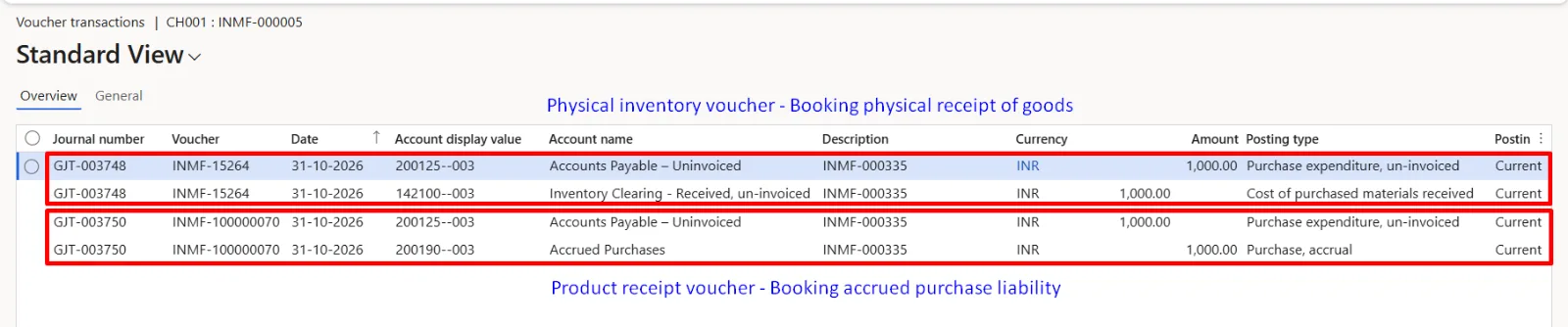
Scenario 1 – Physical inventory and accrual vouchers without tax
Takeaway If 200125 does not net to zero on a stocked-item GRN, one of the two vouchers is missing. Start with the item model group. |
Scenario 2: Adding Tax at receipt
Business scenario: Goods worth INR 1,000 (10 units at INR 100) are received against PO INMF-000310 with Tax.
Configuration: As Scenario 1, but Post physical tax = Yes. The PO line carries tax at 18%, set up as recoverable.
Voucher | Account | Posting type | Debit (INR) | Credit (INR) |
|---|---|---|---|---|
INMF-15232 | 142100 Inventory Clearing – Received, un-invoiced | Cost of purchased materials received | 1,000.00 | |
INMF-15232 | 200125 Accounts Payable – Uninvoiced | Purchase expenditure, un-invoiced | 1,000.00 | |
INMF-100000048 | 131130 Accrued IGST recoverable | India GST | 180.00 | |
INMF-100000048 | 200125 Accounts Payable – Uninvoiced | Purchase expenditure, un-invoiced | 1,000.00 | |
INMF-100000048 | 200190 Accrued Purchases | Purchase, accrual | 1,180.00 |
What’s happening. The physical voucher is identical to Scenario 1. The accrual voucher now also accrues tax: base INR 1,000 × 18% IGST = INR 180, debited to the recoverable-tax account. Accrued Purchases is credited with the tax inclusive INR 1,180, which is what the vendor will bill. The tax document on the receipt confirms the base, rate and amount.
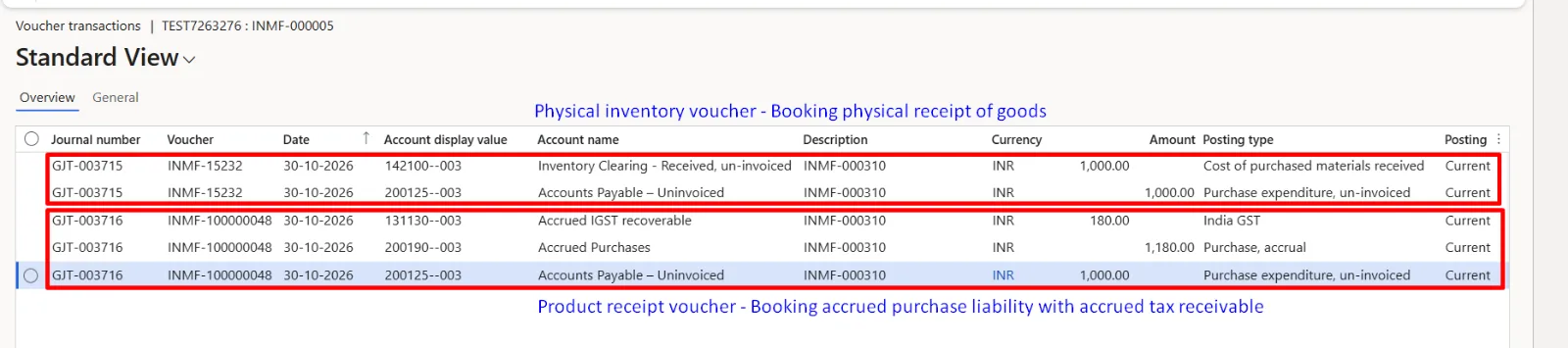
Scenario 2 – Accrual voucher with accrued IGST
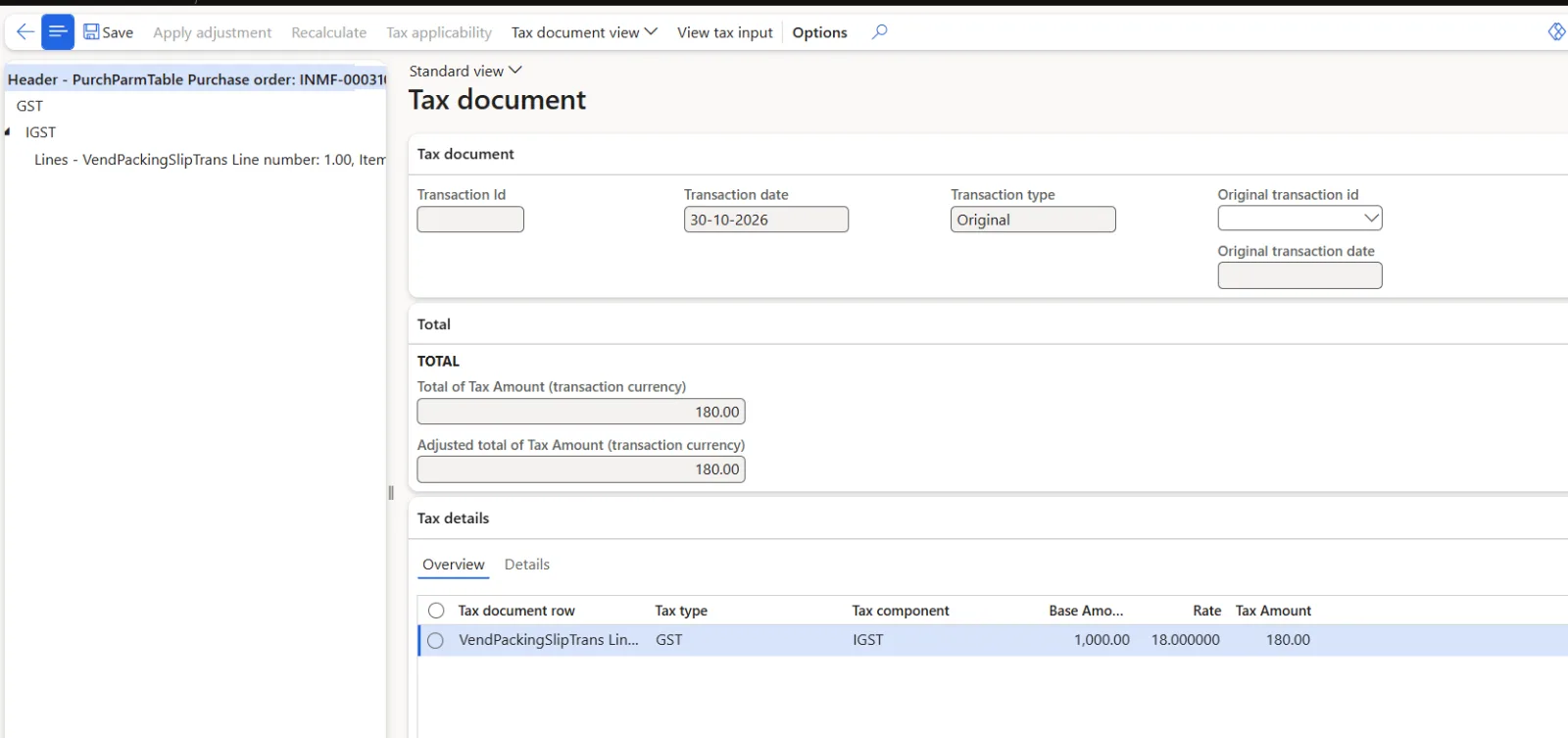
Tax document on the product receipt – IGST base 1,000, rate 18%, tax 180
Expected behaviour. A TAX receipt does not always produce a recoverable-tax debit. With ineligible or non-recoverable ITC, I would expect the tax to load to the cost of the receipt instead. Scenario 4 tests this.
However as per Indian statutory requirements and accounting standards booking tax recoverable is to be done at the time of booking vendor invoice – This is just a show of functionality.
Takeaway Post physical tax only changes the accrual voucher. The physical voucher and the inventory value stay the same. |
Scenario 3: Adding Tax at receipt under reverse charge
Business scenario: Goods worth INR 1,000 (10 units at INR 100) are received against PO INMF-000335 with IGST at 18% under reverse charge, so the tax is payable by the buyer rather than billed by the vendor.
Configuration: As Scenario 2, but the tax on the PO line carries a Reverse charge percentage of 100%, as shown on the tax document.
Voucher | Account | Posting type | Debit (INR) | Credit (INR) |
|---|---|---|---|---|
INMF-15260 | 142100 Inventory Clearing – Received, un-invoiced | Cost of purchased materials received | 1,000.00 | |
INMF-15260 | 200125 Accounts Payable – Uninvoiced | Purchase expenditure, un-invoiced | 1,000.00 | |
INMF-100000066 | 200125 Accounts Payable – Uninvoiced | Purchase expenditure, un-invoiced | 1,000.00 | |
INMF-100000066 | 200190 Accrued Purchases | Purchase, accrual | 1,000.00 | |
INMF-100000066 | 131230 Accrued IGST RCM recoverable | India GST | 180.00 | |
INMF-100000066 | 223130 Accrued IGST RCM payable | India GST | 180.00 |
Scenario 2 vs Scenario 3
Component | Scenario 2 (forward charge) | Scenario 3 (reverse charge) |
|---|---|---|
Tax base and rate | INR 1,000 at 18% | INR 1,000 at 18% |
Tax debit | 131130 Accrued IGST recoverable 180 | 131230 Accrued IGST RCM recoverable 180 |
Tax credit | Included in Accrued Purchases | 223130 Accrued IGST RCM payable 180 |
Accrued Purchases (200190) | INR 1,180 | INR 1,000 |
Expected vendor invoice | INR 1,180 | INR 1,000 |
What’s happening. The physical voucher is the same as Scenario 1. In the accrual voucher, the tax no longer sits inside Accrued Purchases, because under reverse charge the vendor does not bill it. Instead, the system accrues a matching pair: an RCM recoverable (input credit) on the debit side and an RCM payable (liability to the government) on the credit side. Accrued Purchases stays at the goods value of INR 1,000.
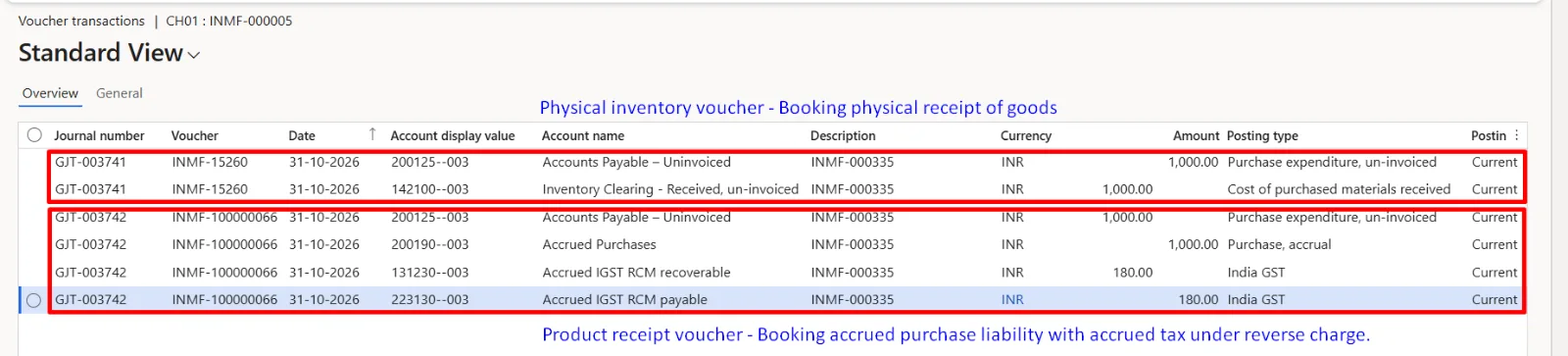
Scenario 3 – Physical inventory and accrual vouchers with accrued tax under reverse charge
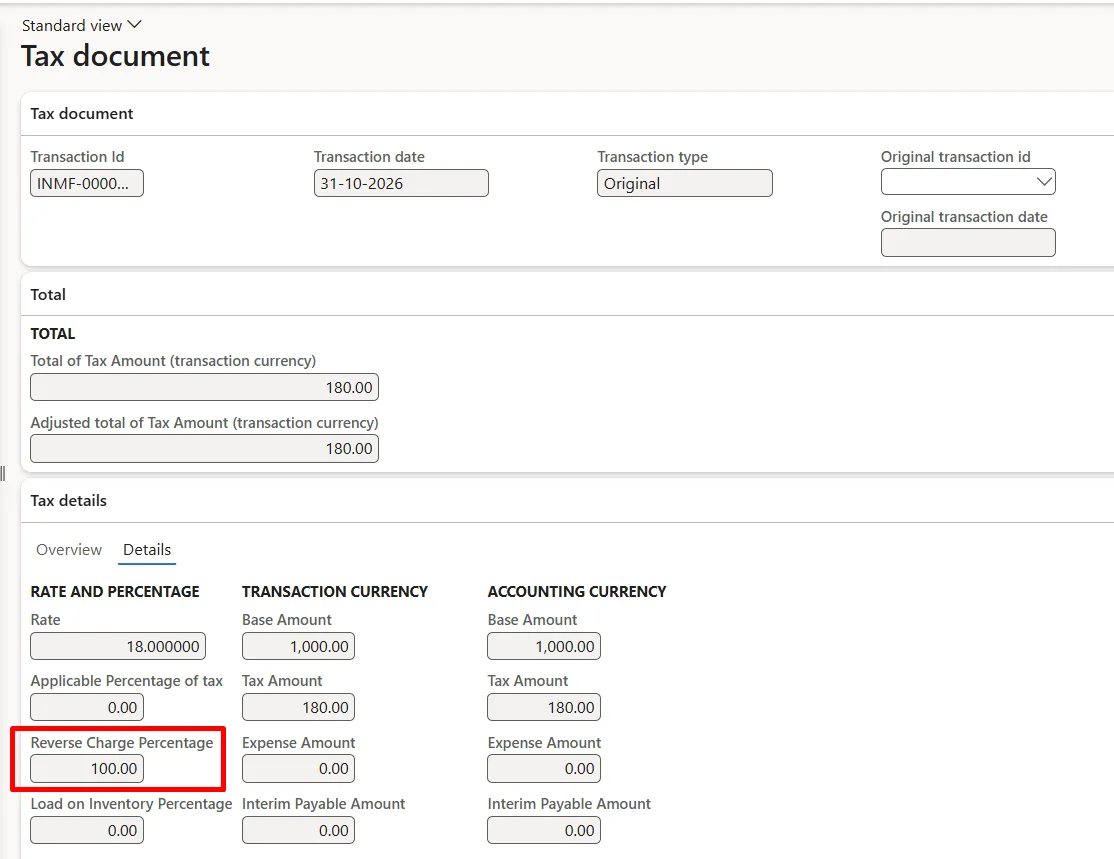
Tax document on the product receipt – Reverse charge percentage 100%, base 1,000, tax 180
Takeaway Under reverse charge, Accrued Purchases excludes the tax. Look for a matched RCM recoverable / RCM payable pair instead of a single recoverable line. |
Scenario 4: Adding Tax at receipt with load on inventory
Business scenario: Goods worth INR 1,000 (10 units at INR 100) are received against PO INMF-000335 with IGST at 18% that is not available as input credit, so the tax becomes part of the cost of the goods.
Configuration: As Scenario 2, but the tax on the PO line carries a Load on inventory percentage of 100%, as shown on the tax document.
Voucher | Account | Posting type | Debit (INR) | Credit (INR) |
|---|---|---|---|---|
INMF-15262 | 142100 Inventory Clearing – Received, un-invoiced | Cost of purchased materials received | 1,180.00 | |
INMF-15262 | 200125 Accounts Payable – Uninvoiced | Purchase expenditure, un-invoiced | 1,180.00 | |
INMF-100000068 | 200125 Accounts Payable – Uninvoiced | Purchase expenditure, un-invoiced | 1,180.00 | |
INMF-100000068 | 200190 Accrued Purchases | Purchase, accrual | 1,180.00 |
What’s happening. There is no tax line at all. The INR 180 of IGST is loaded onto the item, so both vouchers carry the gross value of INR 1,180: inventory clearing is debited with goods plus tax, and Accrued Purchases is credited with the same amount. This confirms the expected behaviour noted in Scenario 2: non-recoverable tax moves into inventory cost instead of a recoverable-tax account.

Scenario 4 – Physical inventory and accrual vouchers with tax loaded on inventory
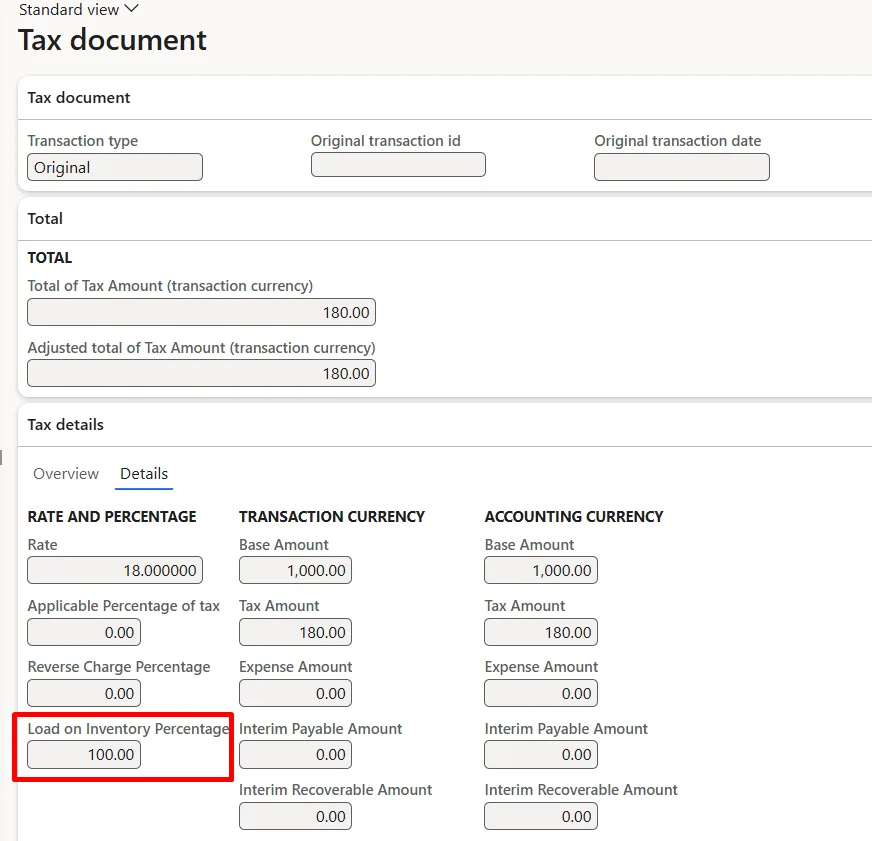
Tax document on the product receipt – Load on inventory percentage 100%, base 1,000, tax 180
Takeaway If the inventory clearing debit equals goods plus tax and no tax line appears, the tax is being loaded on inventory. Check the load on inventory percentage before the posting profile. |
Scenario 5: Freight charge, excluded from the GST base
Business scenario: Goods worth INR 1,000 (10 units at INR 100) are received against PO INMF-000315 with a freight charge of INR 100 on the line (charge code 01, category Pcs., INR 10 per unit × 10 units). Freight is not marked as Assessable value.
Configuration: As Scenario 2, plus Generate charges on product receipt = Yes. Freight charge code 01 is set to Debit Item and Credit Ledger account 600120.
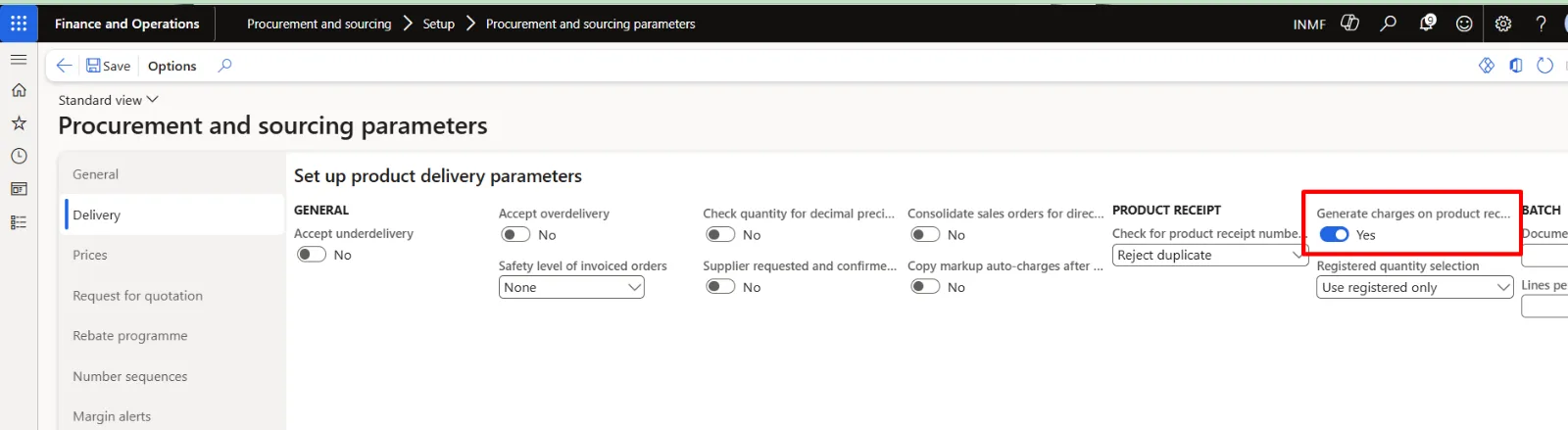
Procurement and sourcing parameters – Generate charges on product receipt
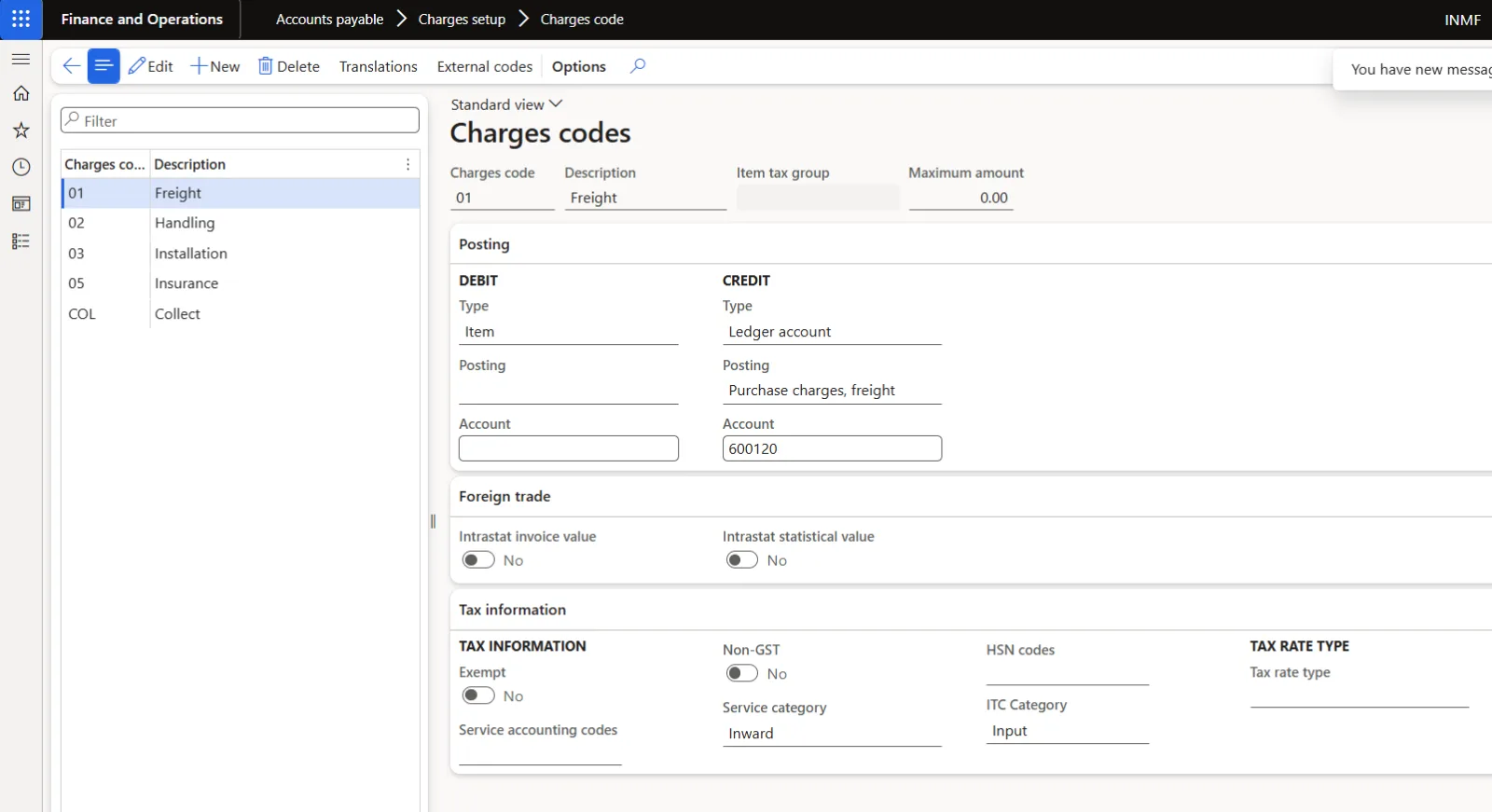
Charges code 01 Freight – Debit Item, Credit Ledger account 600120
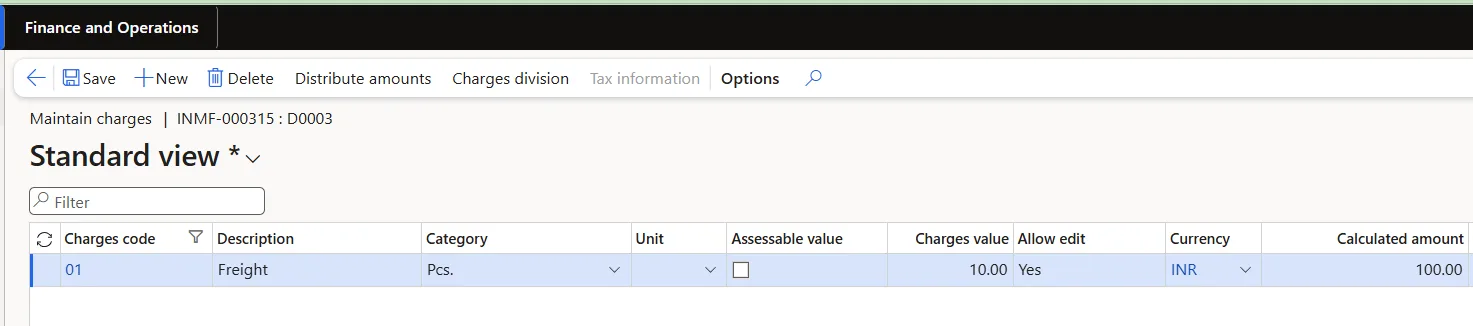
PO line charge – Freight with Assessable value not selected
Voucher | Account | Posting type | Debit (INR) | Credit (INR) |
|---|---|---|---|---|
INMF-15230 | 142100 Inventory Clearing – Received, un-invoiced | Cost of purchased materials received | 1,100.00 | |
INMF-15230 | 200125 Accounts Payable – Uninvoiced | Purchase expenditure, un-invoiced | 1,000.00 | |
INMF-15230 | 600120 Freight/Transportation In | Purchase charges, freight | 100.00 | |
INMF-100000046 | 131130 Accrued IGST recoverable | India GST | 180.00 | |
INMF-100000046 | 200125 Accounts Payable – Uninvoiced | Purchase expenditure, un-invoiced | 1,000.00 | |
INMF-100000046 | 200190 Accrued Purchases | Purchase, accrual | 1,180.00 |
Combined impact (200125 nets to zero)
Account | Debit (INR) | Credit (INR) |
|---|---|---|
142100 Inventory Clearing | 1,100.00 | |
131130 Accrued IGST recoverable | 180.00 | |
600120 Freight/Transportation In | 100.00 | |
200190 Accrued Purchases | 1,180.00 | |
Total | 1,280.00 | 1,280.00 |
Why is freight in the receipt value but credited to 600120? The charge code has Debit type Item, which tells D365 to capitalise the freight into the item’s cost. So, inventory clearing is debited with INR 1,100 (goods 1,000 + freight 100). Because the charge code’s Credit type is Ledger account, the credit does not go to Accrued Purchases. It goes to the charge code’s Credit ledger account, 600120, which acts as the absorption account until the invoice is posted. Scenario 7 shows what changes when the Credit type is Customer/Vendor.
The accrual voucher is the same as Scenario 2. GST stays at INR 180 because the freight is outside the assessable value.
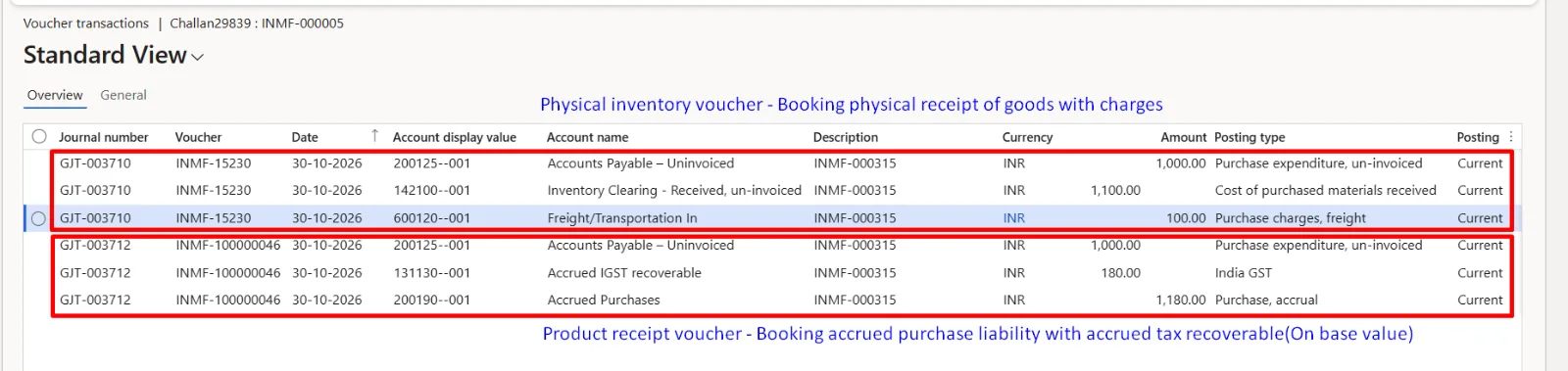
Scenario 5 – Physical voucher with freight absorbed, GST on base value only
Takeaway A freight credit to a P&L account at GRN is by design when the charge is Debit Item / Credit Ledger. If GRN and invoice can fall in different periods, consider a balance sheet account as the charge’s credit account. |
Scenario 6: Freight included in the GST base
Business scenario: As Scenario 5 (10 units at INR 100 = goods INR 1,000, freight INR 10 × 10 units = INR 100 on PO INMF-000315), but freight is marked as Assessable value (product receipt 2352635, 30-10-2026).

PO line charge – Freight with Assessable value selected
Voucher | Account | Posting type | Debit (INR) | Credit (INR) |
|---|---|---|---|---|
INMF-15228 | 142100 Inventory Clearing – Received, un-invoiced | Cost of purchased materials received | 1,100.00 | |
INMF-15228 | 200125 Accounts Payable – Uninvoiced | Purchase expenditure, un-invoiced | 1,000.00 | |
INMF-15228 | 600120 Freight/Transportation In | Purchase charges, freight | 100.00 | |
INMF-100000044 | 131130 Accrued IGST recoverable | India GST | 198.00 | |
INMF-100000044 | 200125 Accounts Payable – Uninvoiced | Purchase expenditure, un-invoiced | 1,000.00 | |
INMF-100000044 | 200190 Accrued Purchases | Purchase, accrual | 1,198.00 |
Scenario 5 vs Scenario 6
Component | Scenario 5 | Scenario 6 |
|---|---|---|
Goods | INR 1,000 | INR 1,000 |
Freight | INR 100 | INR 100 |
GST base | INR 1,000 | INR 1,100 |
IGST at 18% | INR 180 | INR 198 |
Accrued Purchases (200190) | INR 1,180 | INR 1,198 |
Freight account credit (600120) | INR 100 | INR 100 |
Expected vendor invoice (all amounts billed) | INR 1,280 | INR 1,298 |
What’s happening. Only the accrual voucher changes: GST is now 18% of INR 1,100, giving INR 198. Look at the last row, though. Accrued Purchases covers the goods and all the GST, but not the INR 100 freight itself, which is parked in 600120. So, at receipt, Accrued Purchases is INR 100 lower than the expected invoice amount because the freight credit is recorded separately in 600120. The subsequent vendor invoice posting will determine how this balance is cleared. That reconciliation is outside the scope of this post and will be tested in the some future blog.
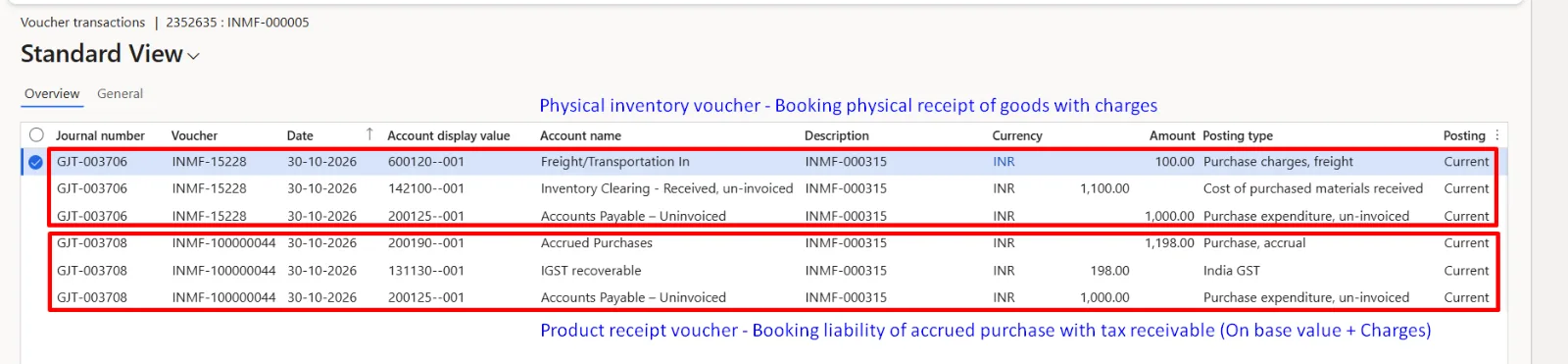
Scenario 6 – Accrual voucher with GST on goods plus freight
Takeaway Assessable value changes the GST accrual, not the freight liability. If finance reconciles Accrued Purchases to expected invoices, the freight gap comes from the charge setup, not from GST. |
Scenario 7: Freight charge debited to item and credited to vendor
Business scenario: Goods worth INR 1,000 (10 units at INR 100) are received against PO INMF-000315 with a freight charge of INR 100 on the line (INR 10 per unit × 10 units), where the freight is billed by the same vendor.
Configuration: As Scenario 5, but freight charge code 01 is set to Debit type Item and Credit type Customer/Vendor. Post physical tax = No for this test, so no tax is accrued at receipt and the voucher shows only the goods and freight.
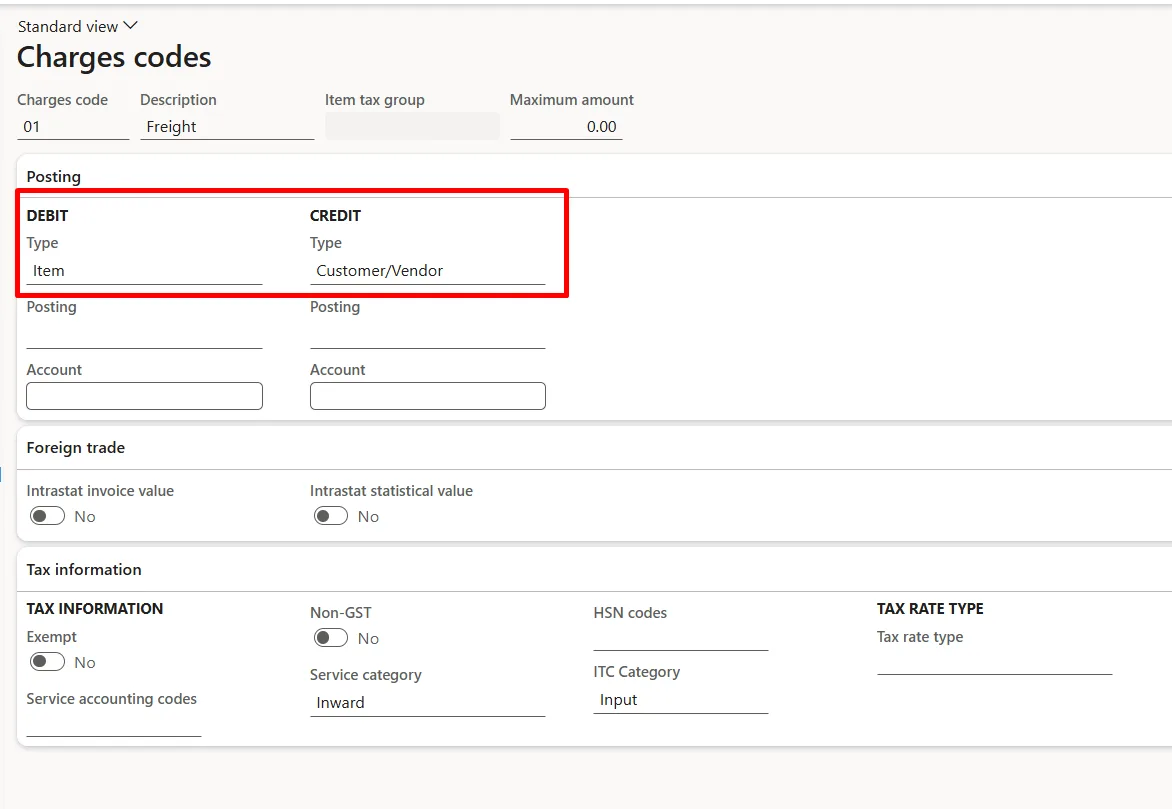
Charges code 01 Freight – Debit Item, Credit Customer/Vendor
Voucher | Account | Posting type | Debit (INR) | Credit (INR) |
|---|---|---|---|---|
INMF-15249 | 142100 Inventory Clearing – Received, un-invoiced | Cost of purchased materials received | 1,100.00 | |
INMF-15249 | 200190 Accrued Purchases | Purchase, accrual | 100.00 | |
INMF-15249 | 200125 Accounts Payable – Uninvoiced | Purchase expenditure, un-invoiced | 1,000.00 | |
INMF-100000065 | 200125 Accounts Payable – Uninvoiced | Purchase expenditure, un-invoiced | 1,000.00 | |
INMF-100000065 | 200190 Accrued Purchases | Purchase, accrual | 1,000.00 |
Scenario 5 vs Scenario 7
Component | Scenario 5 (Credit Ledger) | Scenario 7 (Credit Customer/Vendor) |
|---|---|---|
Inventory clearing debit (142100) | INR 1,100 | INR 1,100 |
Freight credit | 600120 Freight/Transportation In | 200190 Accrued Purchases |
Accrued Purchases for goods + freight | INR 1,000 (goods only) | INR 1,100 (goods + freight) |
Gap to the vendor invoice (excluding tax) | INR 100 | Nil |
What’s happening. The debit side is unchanged: freight is still capitalised, so inventory clearing is debited with INR 1,100. The credit side is different. Because the freight is owed to the vendor, it is credited straight to Accrued Purchases inside the physical voucher, with posting type Purchase, accrual. The accrual voucher carries only the goods value. Across the two vouchers, Accrued Purchases totals INR 1,100, matching what the vendor will bill, and nothing is parked in a P&L account.
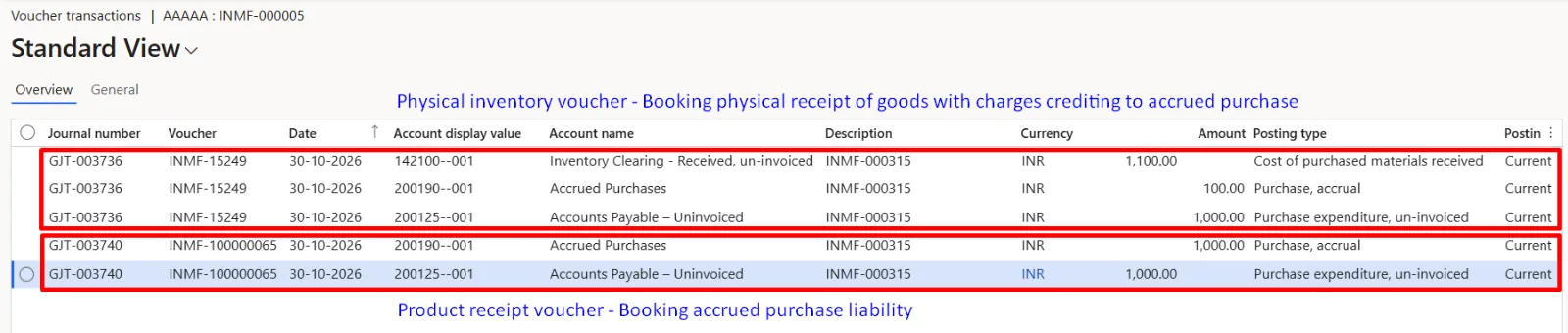
Scenario 7 – Physical voucher with the charge credited to Accrued Purchases
Takeaway If the charge is payable to the same vendor, Debit Item / Credit Customer/Vendor keeps the full liability in Accrued Purchases and closes the freight gap seen in Scenarios 5 and 6. |
Scenario 8: Cancelling the receipt in full
Business scenario: The Scenario 6 receipt (2352635, 10 units at INR 100 plus freight) is cancelled in full, for example because it was posted against the wrong PO. This test was run before the vendor invoice was posted, so do not generalise it to invoiced receipts.
Configuration: Nothing extra. Cancel is run from the posted product receipt journal.
Preconditions I would expect (confirm in your environment):
- The receipt quantity has not been invoiced.
- The received quantity is still on hand and has not been issued, consumed or transferred.
- The ledger period for the cancellation date is open.
Voucher | Account | Posting type | Debit (INR) | Credit (INR) |
|---|---|---|---|---|
INMF-15229 | 600120 Freight/Transportation In | Purchase charges, freight | 100.00 | |
INMF-15229 | 200125 Accounts Payable – Uninvoiced | Purchase expenditure, un-invoiced | 1,000.00 | |
INMF-15229 | 142100 Inventory Clearing – Received, un-invoiced | Cost of purchased materials received | 1,100.00 | |
INMF-100000045 | 200190 Accrued Purchases | Purchase, accrual | 1,198.00 | |
INMF-100000045 | 131130 Accrued IGST recoverable | India GST | 198.00 | |
INMF-100000045 | 200125 Accounts Payable – Uninvoiced | Purchase expenditure, un-invoiced | 1,000.00 |
Balances for this receipt (INR)
Account | After receipt | Cancellation | After cancel |
|---|---|---|---|
142100 Inventory Clearing | 1,100.00 Dr | 1,100.00 Cr | 0.00 |
131130 Accrued IGST recoverable | 198.00 Dr | 198.00 Cr | 0.00 |
600120 Freight/Transportation In | 100.00 Cr | 100.00 Dr | 0.00 |
200190 Accrued Purchases | 1,198.00 Cr | 1,198.00 Dr | 0.00 |
200125 AP – Uninvoiced | 0.00 | 0.00 | 0.00 |
What’s happening. Cancellation posts two new vouchers that mirror the originals line for line with the signs reversed, including the freight absorption and the accrued GST. The originals stay in the ledger, so the audit trail is intact.
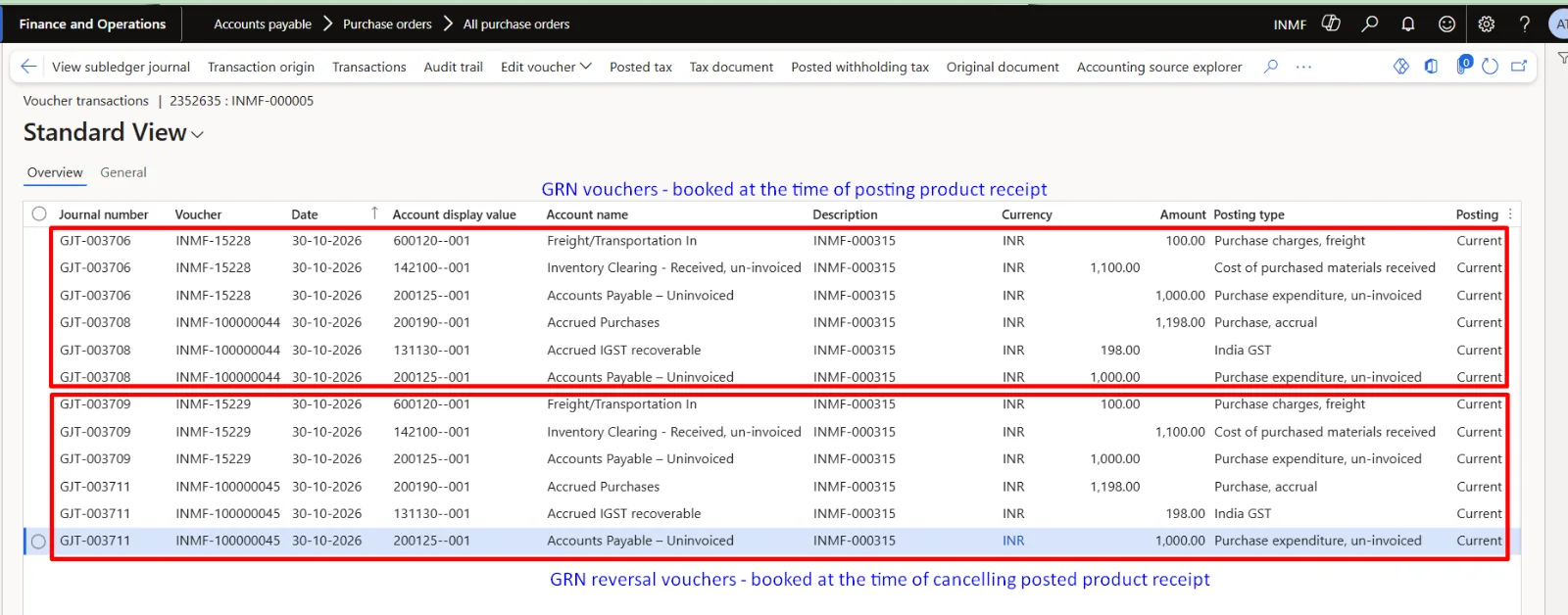
Scenario 8 – Original GRN vouchers and the reversal vouchers on cancellation
Takeaway Cancel reverses everything the receipt posted, charges and tax included. Search by product receipt number to see both sets of vouchers together. |
Scenario 9: Correcting a receipt down
Business scenario: 6 units at INR 100 (INR 600) are received against PO INMF-000317. One unit (INR 100) never arrived, so the receipt is corrected down to 5 units (INR 500) instead of being cancelled. This was also done before the invoice.
Configuration: No tax or charges. Correct is run from the posted product receipt journal, reducing the received quantity.
Voucher | Account | Posting type | Debit (INR) | Credit (INR) |
|---|---|---|---|---|
INMF-15241 | 142100 Inventory Clearing – Received, un-invoiced | Cost of purchased materials received | 600.00 | |
INMF-15241 | 200125 Accounts Payable – Uninvoiced | Purchase expenditure, un-invoiced | 600.00 | |
INMF-100000057 | 200125 Accounts Payable – Uninvoiced | Purchase expenditure, un-invoiced | 600.00 | |
INMF-100000057 | 200190 Accrued Purchases | Purchase, accrual | 600.00 | |
INMF-15242 | 200125 Accounts Payable – Uninvoiced | Purchase expenditure, un-invoiced | 100.00 | |
INMF-15242 | 142100 Inventory Clearing – Received, un-invoiced | Cost of purchased materials received | 100.00 | |
INMF-100000058 | 200190 Accrued Purchases | Purchase, accrual | 100.00 | |
INMF-100000058 | 200125 Accounts Payable – Uninvoiced | Purchase expenditure, un-invoiced | 100.00 |
Net impact (INR)
Account | Original receipt | Correction | Net impact |
|---|---|---|---|
142100 Inventory Clearing | 600.00 Dr | 100.00 Cr | 500.00 Dr |
200125 AP – Uninvoiced | 600.00 Dr; 600.00 Cr | 100.00 Dr; 100.00 Cr | Dr 700.00, Cr 700.00, net 0.00 |
200190 Accrued Purchases | 600.00 Cr | 100.00 Dr | 500.00 Cr |
What’s happening. The correction posts only the difference. The original pair of vouchers stays for INR 600, and a new pair reverses INR 100 from inventory clearing and Accrued Purchases. The net GRN of INR 500 matches what was received.
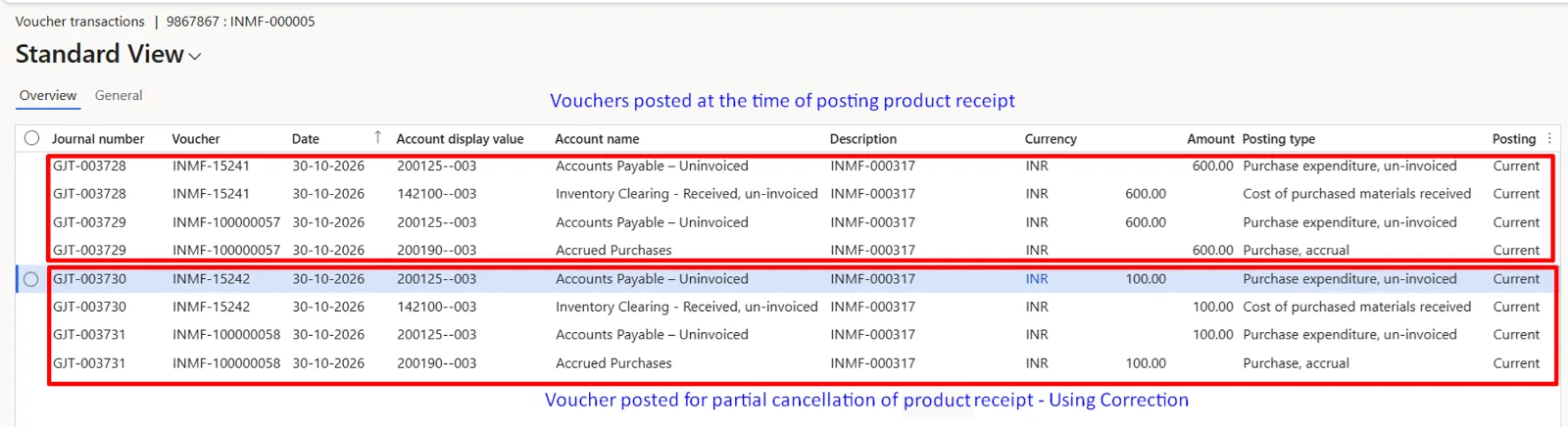
Scenario 9 – Original receipt and correction vouchers
Takeaway Correction is a delta, not a cancel-and-repost. When reconciling, add the correction vouchers to the original rather than looking for a full reversal. |
Scenario 10: Switching off Post physical inventory
Business scenario: 5 units at INR 100 (INR 500) are received against PO INMF-000317 (product receipt AAAY, 30-10-2026) after physical inventory posting was switched off on the item model group.
Configuration: Item model group Stocked with Post physical inventory = No. Post financial inventory and Accrue liability on product receipt remain Yes. Include physical value is selected in this screenshot. No tax or charges.
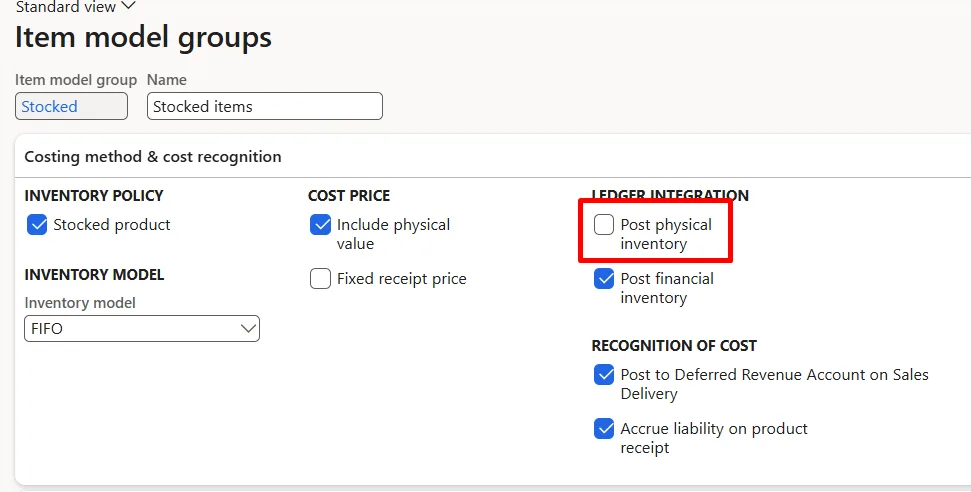
Item model group Stocked – Post physical inventory disabled
Voucher | Account | Posting type | Debit (INR) | Credit (INR) |
|---|---|---|---|---|
INMF-100000061 | 200125 Accounts Payable – Uninvoiced | Purchase expenditure, un-invoiced | 500.00 | |
INMF-100000061 | 200190 Accrued Purchases | Purchase, accrual | 500.00 |
What’s happening. With physical posting off, there is no physical voucher, so inventory clearing is never debited. The accrual voucher still posts because Accrue liability remains on. The result is a debit of INR 500 sitting in 200125 with nothing to offset it, unlike every stocked-item scenario above.

Scenario 10 – Accrual voucher only, with no physical inventory voucher
Takeaway An unexplained debit balance in AP – Uninvoiced is a strong sign that some item model groups accrue liability without posting physical inventory. If that is deliberate, reconcile 200125 against open receipts; if not, fix the item model group. |
Scenario 11: Standard cost and the purchase price variance
Business scenario: Standard cost item is received against PO INMF-000318 at INR 10,000, against an active standard cost of INR 9,000. No GST.
Configuration: Item model group with inventory model Standard cost, Post physical inventory and Accrue liability on product receipt enabled. Standard cost of INR 9,000 is active on Site 1 from 30-10-2026. Purchase price variance is mapped to 510310 on the Standard cost variance tab.
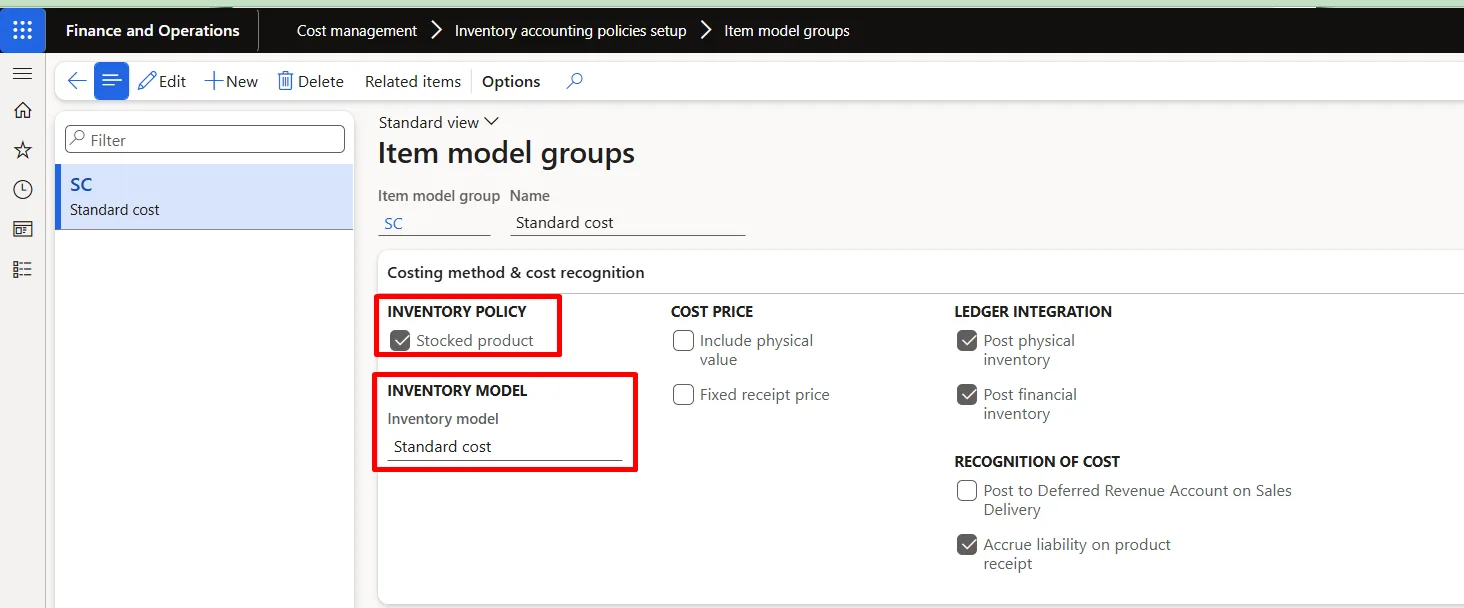
Item model group SC – Inventory model Standard cost

Item price – active standard cost of INR 9,000 for P-000020
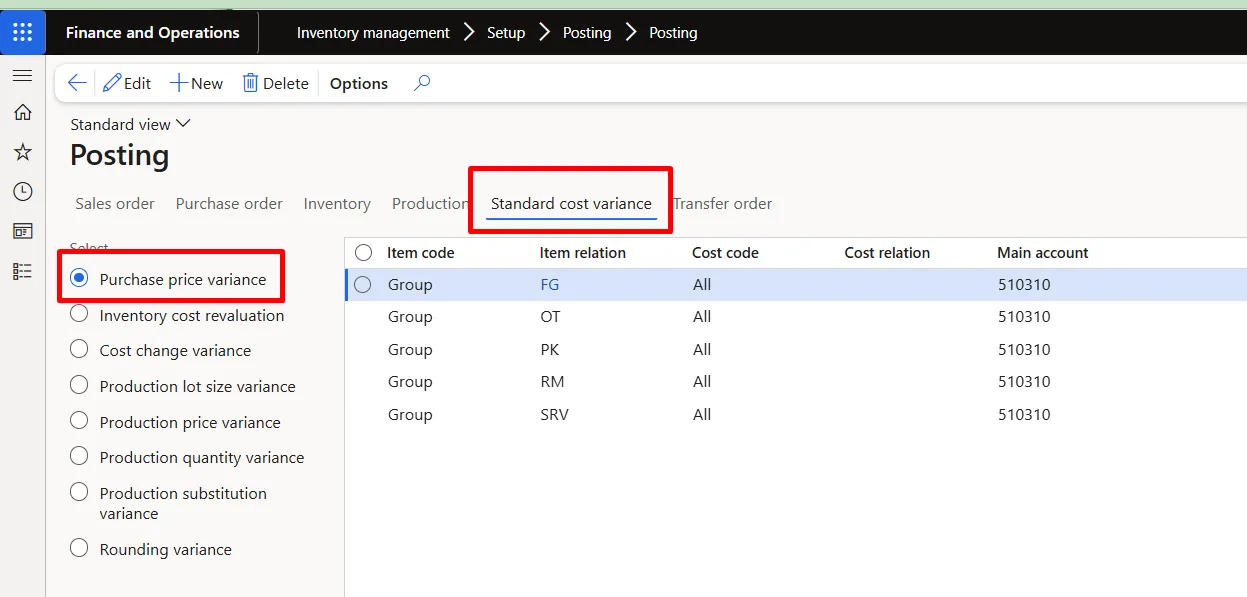
Inventory posting – Standard cost variance tab: Purchase price variance mapped to 510310
Voucher | Account | Posting type | Debit (INR) | Credit (INR) |
|---|---|---|---|---|
INMF-15244 | 142100 Inventory Clearing – Received, un-invoiced | Cost of purchased materials received | 9,000.00 | |
INMF-15244 | 510310 Purchase Price Variance | Purchase price variance | 1,000.00 | |
INMF-15244 | 200125 Accounts Payable – Uninvoiced | Purchase expenditure, un-invoiced | 10,000.00 | |
INMF-100000060 | 200125 Accounts Payable – Uninvoiced | Purchase expenditure, un-invoiced | 10,000.00 | |
INMF-100000060 | 200190 Accrued Purchases | Purchase, accrual | 10,000.00 |
Component | Amount (INR) | Posted to | Why |
|---|---|---|---|
Standard cost value | 9,000 | Dr 142100 | Inventory is always carried at the active standard cost |
Price above standard | 1,000 | Dr 510310 | Excess of PO price over standard, recognised at receipt |
Full purchase price | 10,000 | Cr 200125, then Cr 200190 | Un-invoiced expenditure and the accrual reflect what the vendor will bill |
What’s happening. Under standard cost the receipt is valued at standard, and the INR 1,000 unfavourable variance is booked at GRN. FIFO items (Scenarios 1–9) behave differently: they are valued at PO price and show no variance at receipt. In this configuration the variance stays in P&L and is not reversed at invoice. That is the result of this setup, not a universal rule, and any further price difference at invoice would post separately.
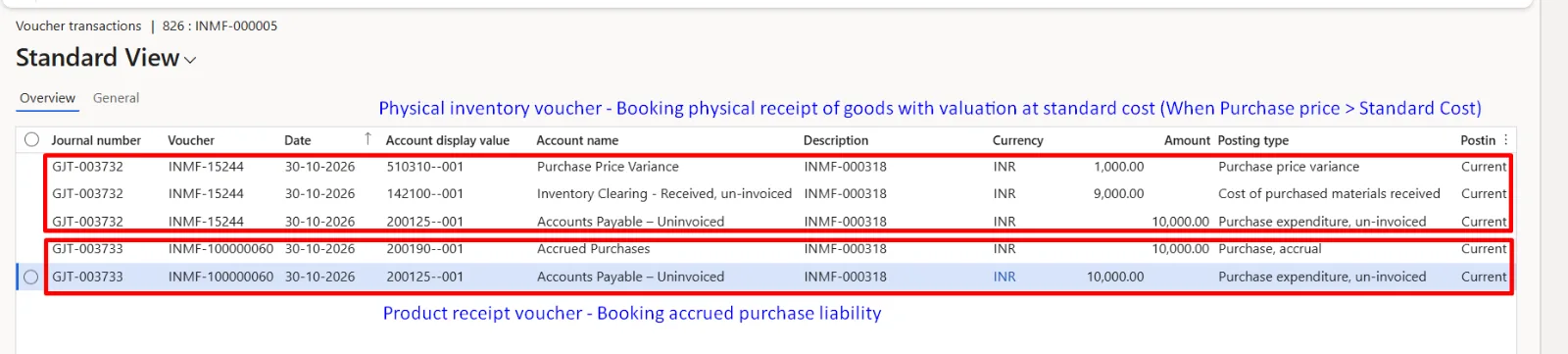
Scenario 11 – Physical voucher at standard cost with purchase price variance
Takeaway A PPV on a GRN voucher is normal for standard cost items. If you expected one and do not see it, check the active cost version and site before the posting profile. |
Scenario 12: Service receipts on a procurement category line
Business scenario: A repair service worth INR 1,50,000 (1,500 units at INR 100) is received against PO INMF-000316 on a procurement category line (no item). I ran it twice on 30-10-2026: 12A without GST and 12B with IGST at 18%.
Configuration: Post product receipt in ledger = Yes and Post physical tax = Yes. A category line has no inventory, so the item model group does not apply. In the posting profile, Purchase expenditure, un-invoiced has a Category row for Repair & Maintenance mapped to 605141, sitting above the item-group rows that point to 200125.
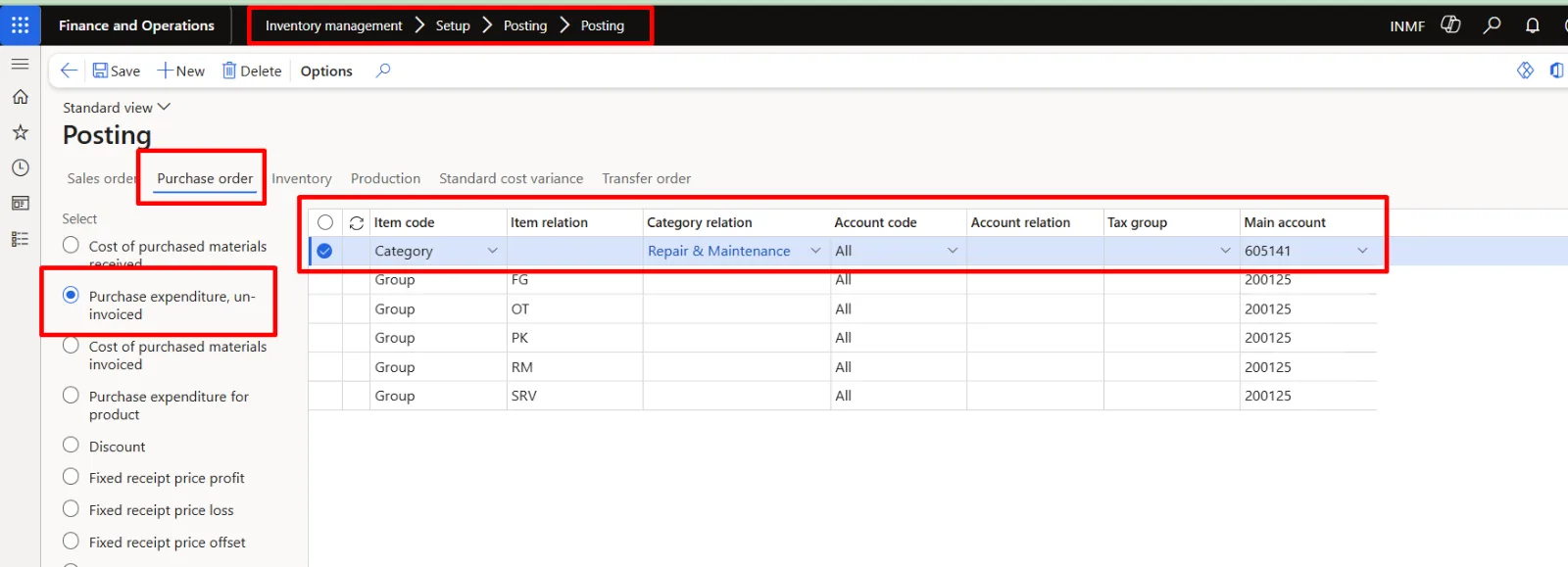
Inventory posting – Purchase expenditure, un-invoiced: category Repair & Maintenance mapped to 605141
12A – Without GST
Voucher | Account | Posting type | Debit (INR) | Credit (INR) |
|---|---|---|---|---|
INMF-100000052 | 605141 Provisional – Repair Expenses | Purchase expenditure, un-invoiced | 1,50,000.00 | |
INMF-100000052 | 200190 Accrued Purchases | Purchase, accrual | 1,50,000.00 |

Scenario 12A – Accrued purchase for service received, without GST
12B – With GST
Voucher | Account | Posting type | Debit (INR) | Credit (INR) |
|---|---|---|---|---|
INMF-100000054 | 605141 Provisional – Repair Expenses | Purchase expenditure, un-invoiced | 1,50,000.00 | |
INMF-100000054 | 131130 Accrued IGST recoverable | India GST | 27,000.00 | |
INMF-100000054 | 200190 Accrued Purchases | Purchase, accrual | 1,77,000.00 |
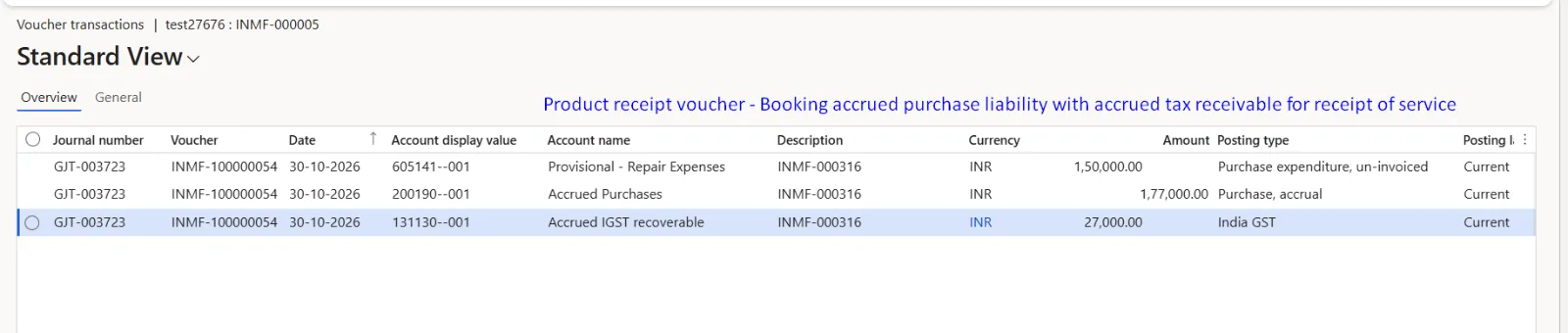
Scenario 12B – Accrued purchase for service received, with accrued IGST
What’s happening. A service receipt posts a single voucher and no physical inventory voucher, because nothing enters inventory. The same posting type that uses 200125 for stocked items, Purchase expenditure, un-invoiced, here resolves to 605141 through the category row, so the expense hits P&L at receipt. The only difference in 12B is the tax: INR 27,000 (18% of 1,50,000), which lifts Accrued Purchases to INR 1,77,000.
Takeaway For category lines, Purchase expenditure, un-invoiced is your expense account. If a service GRN lands in 200125, the category row is missing or the line’s category does not match it. |
Scenario 13: Purchase return (cost = return value)
Business scenario: 10 units previously received at INR 100 each (INR 1,000) are returned to the vendor on PO INMF-000336, using a negative-quantity line (–10 units) posted as product receipt PR_RMA_01 on 31-10-2026. The return line carries the same unit price of INR 100, so the return value equals the cost of the stock being returned.
Configuration: As Scenario 1. No tax or charges.
Voucher | Account | Posting type | Debit (INR) | Credit (INR) |
|---|---|---|---|---|
INMF-15266 | 200125 Accounts Payable – Uninvoiced | Purchase expenditure, un-invoiced | 1,000.00 | |
INMF-15266 | 142100 Inventory Clearing – Received, un-invoiced | Cost of purchased materials received | 1,000.00 | |
INMF-100000072 | 200190 Accrued Purchases | Purchase, accrual | 1,000.00 | |
INMF-100000072 | 200125 Accounts Payable – Uninvoiced | Purchase expenditure, un-invoiced | 1,000.00 |
What’s happening. A return is a receipt with the signs reversed. The physical voucher takes the goods out of inventory clearing at their cost of INR 1,000, and the accrual voucher reduces Accrued Purchases by the return value of INR 1,000. Because the two amounts are equal, 200125 nets to zero, exactly as in Scenario 1.
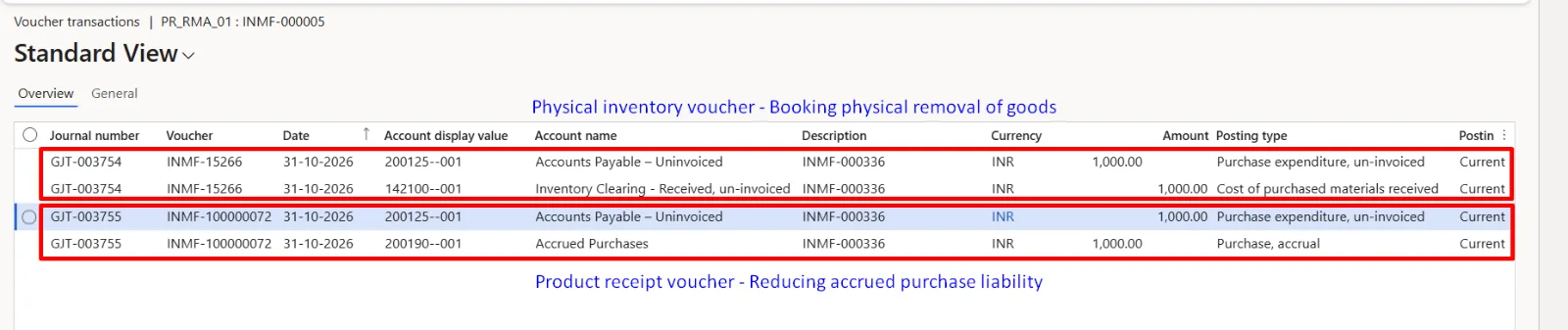
Scenario 13 – Physical removal of goods and reduction of accrued purchase liability
Takeaway When the return value equals the cost of the returned stock, a return is a clean mirror image of the original receipt. |
Scenario 14: Purchase return (cost > return value)
Business scenario: 10 units that were received at INR 100 each (cost INR 1,000) are returned to the vendor on PO INMF-000337 (product receipt PR_RMA_02, 31-10-2026). The return line (–10 units) was created without reference to the original receipt and carries a unit price of INR 90, so the return value is only INR 900.
Configuration: As Scenario 13, except that the return line is created without reference to the original receipt and the unit price is entered manually as INR 90. No tax or charges.
Voucher | Account | Posting type | Debit (INR) | Credit (INR) |
|---|---|---|---|---|
INMF-15268 | 142100 Inventory Clearing – Received, un-invoiced | Cost of purchased materials received | 1,000.00 | |
INMF-15268 | 200125 Accounts Payable – Uninvoiced | Purchase expenditure, un-invoiced | 1,000.00 | |
INMF-100000074 | 200190 Accrued Purchases | Purchase, accrual | 900.00 | |
INMF-100000074 | 200125 Accounts Payable – Uninvoiced | Purchase expenditure, un-invoiced | 900.00 |
Combined impact (INR)
Account | Physical voucher | Accrual voucher | Net impact |
|---|---|---|---|
142100 Inventory Clearing | 1,000.00 Cr | – | 1,000.00 Cr |
200190 Accrued Purchases | – | 900.00 Dr | 900.00 Dr |
200125 AP – Uninvoiced | 1,000.00 Dr | 900.00 Cr | 100.00 Dr (not cleared) |
Control account mismatch The physical voucher removes the goods at their cost (INR 1,000), but the accrual voucher reduces the liability only at the return value (INR 900). The INR 100 difference stays in Accounts Payable – Uninvoiced (200125) and does not clear on its own. In this test the return was created without reference to the original receipt at a unit price of INR 90 (10 × 10 = INR 100 difference). A similar mismatch may occur when a return is created without reference to the original receipt or when its return value differs from the original inventory cost. Validate the inventory cost and return value before posting. Before posting a return, check that the return value matches the cost of the stock being returned. After posting, reconcile 200125 by product receipt so that any residue is traced to the return that caused it. |
What’s happening. Unlike Scenario 13, the two vouchers no longer agree. Inventory leaves at the cost recorded when it was received (10 × INR 100), while the liability is reversed at the price on the return line (10 × INR 90). 200125, which nets to zero in every other stocked-item scenario, is left with a debit of INR 100 that shows up as a reconciliation difference in the control account.

Scenario 14 – Goods removed at cost, liability reduced at return value
Takeaway A residual balance in AP – Uninvoiced after a return points to a return value that differs from cost. Create returns with reference to the original receipt and avoid changing the value on the return line. |
Every GRN voucher in this post was first recorded as a subledger journal entry and only then transferred to the general ledger. When a product receipt is posted, D365 creates the accounting for the source document in the subledger; a separate transfer step creates the general ledger voucher and updates ledger balances.
How the transfer is controlled
The transfer is set per source document type in General ledger > Ledger setup > General ledger parameters > Batch transfer rules, using the Transfer mode field. Two modes are in use today:
Transfer mode | How it works | When to use |
|---|---|---|
Asynchronous | The transfer is scheduled immediately and the ledger voucher is created as soon as server resources are available. Requires the batch server to be running. | Default choice for most document types |
Scheduled batch | Entries are queued and transferred by the Batch transfer for subledger journals job at the scheduled time, in the order they were received. | High volumes or contention in the general ledger, or when a document type must reach the ledger at set times |
The older Synchronous mode, which posted straight to the ledger at the time of posting, has been deprecated.
Why it matters for GRN accounting
- Timing. Until the entry is transferred, the voucher does not appear in ledger balances, the trial balance or financial reports, even though the product receipt shows as posted.
- Reconciliation. Subledger reports (such as the open GRN report below) and the ledger balances of 142100, 200125 and 200190 will disagree until every entry is transferred.
- Period close. Pending entries must be transferred before closing a period, or the receipts land in the ledger after the books are reviewed.
- Troubleshooting. A “missing” GRN voucher is often an untransferred subledger entry rather than a configuration problem.
Checking and transferring pending entries
Open General ledger > Periodic tasks > Subledger journal entries not yet transferred. Each row shows the subledger journal, source document type (for example, Product receipt), document number, accounting date and period. From here you can post the entry immediately with Transfer now, or queue it with Transfer in batch. To transfer everything for a document type and period at once, use Batch transfer for subledger journals.
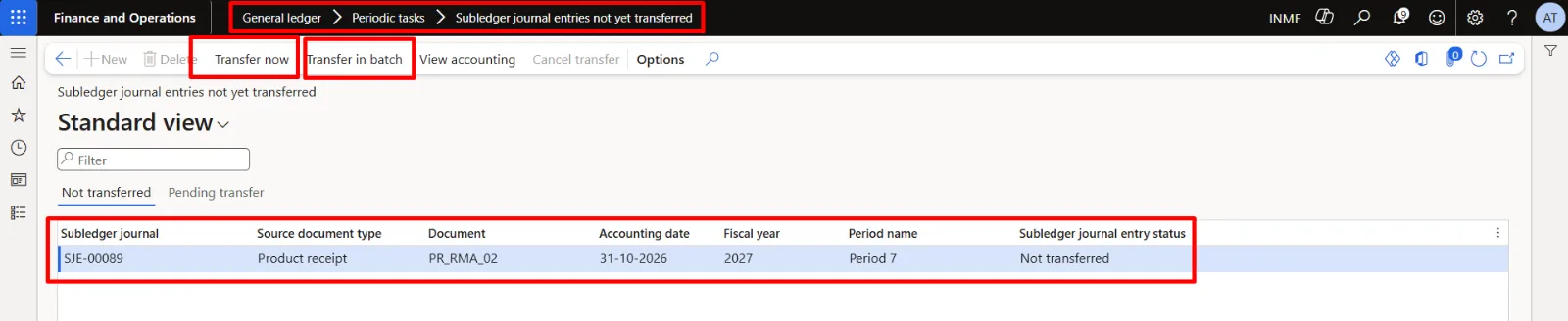
Subledger journal entries not yet transferred – product receipt PR_RMA_02 awaiting transfer
Once entries are in the ledger, the question becomes which receipts are still open. Use Accounts payable > Enquiries and reports > Invoice > Accrued purchases excluding tax report. It lists purchases accrued against product receipts that have been posted but not yet invoiced, which is the goods-received-not-invoiced position behind Accrued Purchases (200190) and Accounts Payable – Uninvoiced (200125).
Parameter | Use |
|---|---|
Cutoff date | Returns the open position as at that date, for period-end accrual reconciliation |
Display items accruing receipt liability | Controls whether items that accrue receipt liability are included in the output |
Cutoff date for including corrected receipts | Decides which date (for example, Accounting date) is used to include corrected receipts such as Scenario 9 |
Run it at each period end and compare the total with the ledger balance of the accrual account. Differences usually come from untransferred subledger entries, receipts posted without physical posting (Scenario 10), or returns posted at a value different from cost (Scenario 14).
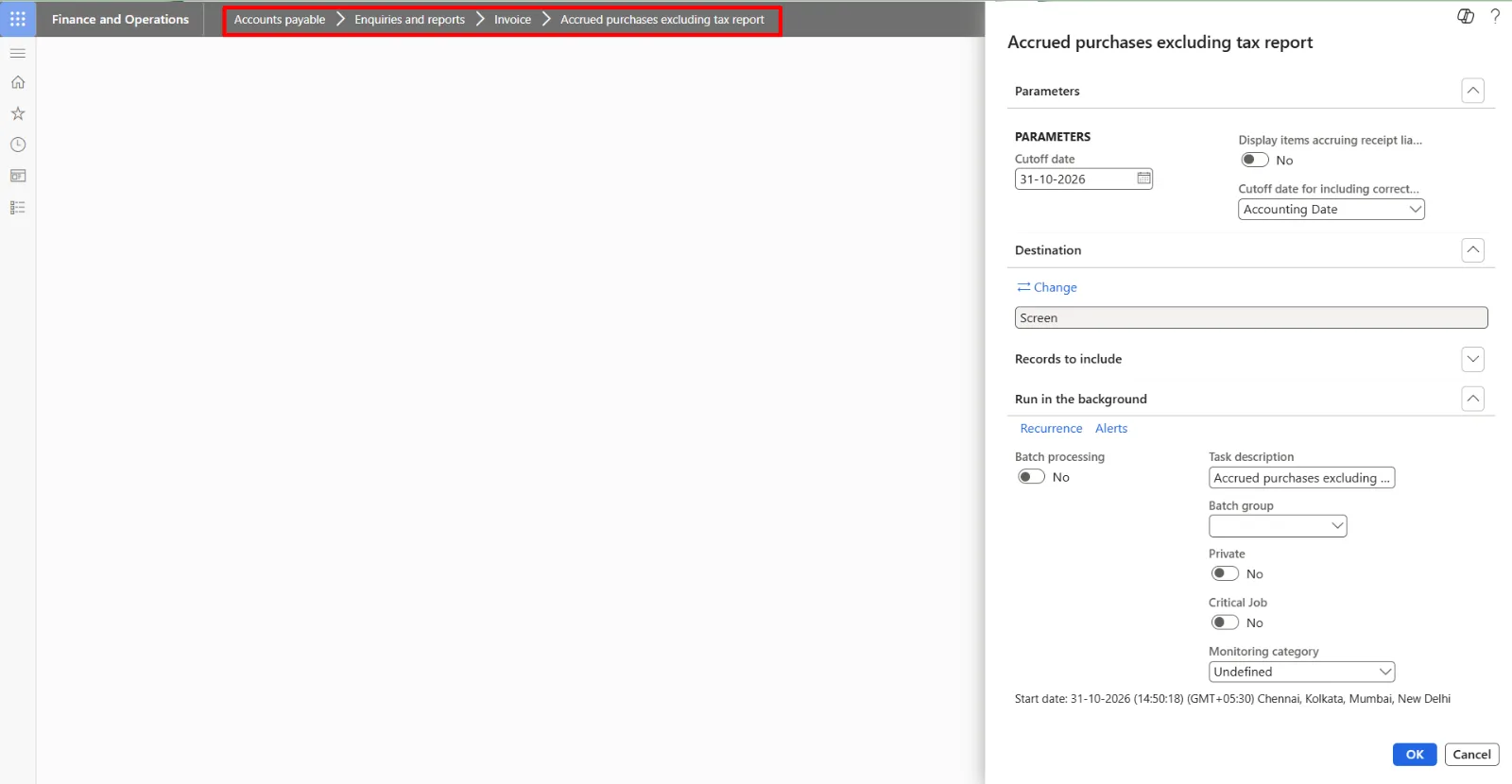
Accrued purchases excluding tax report – parameters
I covered this report in detail, with a sample output, in my previous post on Accounts Payable inquiries and reports.
- Read the GRN as two vouchers. The physical voucher answers “what came in and at what value”; the accrual voucher answers, “what do we owe.” 200125 is the bridge between them.
- Separate “did it post” from “where did it post.” Parameters and item model groups decide the first; the posting profile, charge codes and tax setup decide the second.
- Item/Ledger charges inflate the receipt value, not the accrual. Expect Accrued Purchases to be lower than the vendor invoice by the freight amount, unless the charge is credited to Customer/Vendor.
- Assessable value is a GST switch only. It moves the tax accrual, not the freight liability.
- Tax treatment changes the shape of the accrual. Recoverable tax adds a tax line, reverse charge adds a recoverable/payable pair, and load on inventory moves the tax into the item cost.
- Cancel and Correct behave differently. Cancel mirrors the whole receipt; Correct posts only the delta.
- Category lines use the same posting type for a different job. Purchase expenditure, un-invoiced becomes the P&L expense account.
- Standard cost moves the variance to GRN. The PPV is booked at receipt, from the Standard cost variance tab.
- Returns must go back at cost. A return value that differs from the cost of the returned stock leaves a balance in AP – Uninvoiced.
When a GRN voucher does not match expectations, work through this list in order:
☐ Is the PO line a stocked item, a non-stocked or service item, or a procurement category?
☐ Is physical posting on: Post product receipt in ledger, and Post physical inventory on the item model group?
☐ Is Accrue liability on product receipt enabled?
☐ Is Post physical tax enabled, and does the tax document on the receipt show the expected base, rate, reverse charge and load on inventory percentages?
☐ Are charges set to post at receipt: Generate charges on product receipt = Yes, charges on the line (or allocated to it), and a suitable debit/credit type on the charge code?
☐ Is the charge marked as Assessable value on the PO line?
☐ Do the posting profile rows for the item group or category point to the accounts you expect?
☐ Has the receipt already been corrected, cancelled or invoiced?
☐ For a return, was it created with reference to the original receipt, and does the return value equal the cost of the returned stock?
☐ Has the subledger journal entry been transferred to the general ledger?
☐ Does the voucher match the expected pattern for this configuration from the scenarios above?
If you have hit a GRN voucher that does not fit any of these patterns, I would like to hear about it. It may end up as a scenario in the next post.